31 Days of October: A Photo + Writing Challenge
There’s something about October that makes the darkness feel a little different.
Suddenly, black cats are everywhere. Witches decorate our front porches. Skeletons hang from windows, haunted houses become weekend entertainment, and people willingly pay money to have someone jump out of the shadows and scare them half to death.
And we LOVE it.
But have you ever stopped to wonder why?
Why does October make us so fascinated with the darker, spookier side of life?
Personally, I’ve always been fascinated by the paranormal, haunted history, witchcraft, and the mysteries of the unknown. So, for me, that curiosity doesn’t disappear when November arrives.
But I think there’s something much deeper behind our collective fascination with Halloween.
And it starts with history.
Before Halloween, There Was Samhain
Long before Halloween became a holiday filled with candy, costumes, and elaborate decorations, ancient Celtic communities celebrated Samhain (pronounced roughly “SOW-in”).
Samhain marked the transition from the harvest season into winter, a time associated with shorter days, longer nights, and the approaching cold.
It was a significant seasonal turning point.
In Irish folklore and later traditions, Samhain became associated with supernatural encounters and the boundaries between the human world and the Otherworld.
And this is where things get especially fascinating.
When the Veil Between Worlds Grows Thin
Have you ever heard someone say that the veil between the living and the dead is thinner around Halloween?
It’s one of my favorite concepts associated with this time of year.
In modern spiritual and pagan traditions, Samhain is often described as a time when the veil separating our world from the spirit world becomes thinner.
The idea is that communication with spirits, ancestors, and otherworldly beings may be easier during this period.
Of course, there’s no scientific evidence that a literal spiritual veil becomes thinner in October. It’s a spiritual belief rather than an established fact.
But isn’t the folklore fascinating?
Whether someone believes in spirits or simply appreciates the symbolism, there’s something meaningful about a season that encourages us to remember those who came before us.
Perhaps that’s part of why we’re drawn to the mysterious.
It’s not always about fear.
Sometimes it’s about connection, remembrance, and curiosity about what might exist beyond the world we know.
How Did Halloween Become What It Is Today?
Here’s where the history gets even more interesting.
Halloween wasn’t created overnight.
The holiday we recognize today developed through centuries of changing religious observances, regional customs, immigration, and popular culture.
The name Halloween comes from All Hallows’ Eve, the evening before All Saints’ Day on November 1.
Over time, customs associated with the Christian observances of All Saints’ and All Souls’ Days became intertwined with regional autumn traditions and folklore.
The precise relationship between ancient Samhain customs and modern Halloween traditions is still debated by historians.
But what we do know is that Halloween continued evolving.
Costumes, disguises, lanterns, community celebrations, and eventually trick-or-treating all became part of the holiday’s story.
Irish and Scottish immigrants helped bring Halloween traditions to North America, where they continued to change.
And somewhere along the way, an ancient season of transition became a celebration of candy, costumes, scary movies, and haunted attractions.
What an evolution!
Why Does Black Feel Like the Color of Halloween?
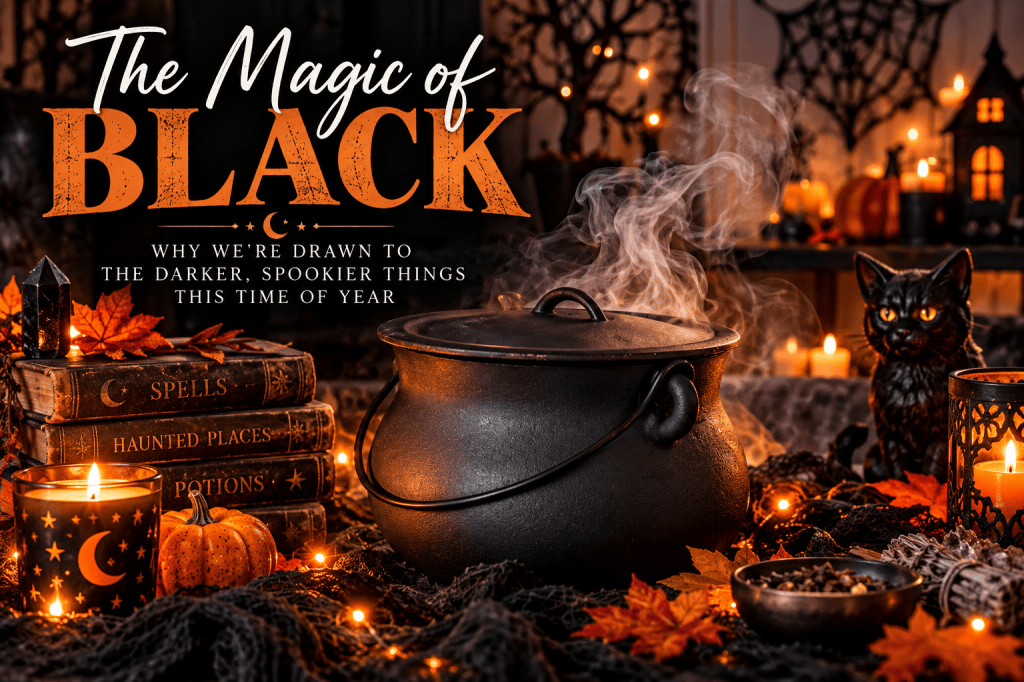
Today’s photo challenge is BLACK.
And honestly, could there be a more appropriate color for this season?
Black represents darkness, mystery, and the unknown.
It’s the color of shadows, midnight skies, witch hats, and silhouettes against the moon.
But black doesn’t have to represent something evil.
To me, it can also represent curiosity, elegance, protection, and the mysteries we haven’t yet uncovered.
When the days grow shorter and darkness arrives earlier, our surroundings naturally begin to feel different.
Suddenly, candlelight feels warmer. A creaking floorboard sounds a little more suspicious. And an old abandoned building seems to have a thousand stories waiting to be told.
Maybe October simply gives us permission to explore the things that intrigue us all year long.
Are We Really Afraid of the Dark?
I think there’s a difference between being afraid of something and being fascinated by it.
Think about how many people love true crime documentaries, paranormal investigations, ghost stories, and horror movies.
We willingly explore frightening subjects from the comfort and relative safety of our homes.
There’s even a psychological explanation for some of this fascination.
Researchers have explored how frightening entertainment can allow people to experience fear in a controlled environment, where the excitement is real but the danger isn’t.
And when you combine that with centuries of Halloween folklore, it’s easy to understand why spooky season has such a hold on us.
The darkness becomes entertainment.
The unknown becomes an adventure.
And the things that might frighten us on an ordinary Tuesday suddenly become part of the magic of October.
The Magic Is in the Mystery
What fascinates me most about Halloween isn’t necessarily the costumes or the candy.
It’s the history.
It’s knowing that generations of people celebrated this time of year long before our modern traditions existed.
It’s wondering what they believed, what frightened them, and how those beliefs influenced the celebrations we still enjoy today.
It’s the folklore surrounding spirits, the changing seasons, and the mysteries of life and death.
And perhaps that’s why I love this season so much.
Halloween allows history, spirituality, imagination, and a little bit of darkness to exist together.
You don’t have to believe in ghosts to appreciate a good ghost story.
You don’t have to practice witchcraft to find its history fascinating.
And you certainly don’t have to love horror movies to appreciate the centuries of tradition behind Halloween.
Sometimes, curiosity is magical enough on its own.
So, why are we drawn to darker, spookier things this time of year?
Maybe it’s because Halloween has spent centuries teaching us that darkness doesn’t always have to be frightening.
Sometimes, it’s where the most fascinating stories begin.
Until next time, stay curious, embrace a little mystery, and keep finding magic in the everyday.
 LexTalk
Let’s Talk! 
Did you know about the history of Samhain and Halloween? Do you believe the veil between worlds becomes thinner this time of year, or do you simply love the spooky traditions?
I’d love to hear what draws you to Halloween’s darker side!


Leave a Reply