Sometimes the scariest stories aren’t the ones Hollywood creates. They’re the ones Mother Nature is capable of writing herself.
Back in 2020, I watched a documentary about natural disasters that absolutely terrified me.
I’m pretty sure it was an episode of Mega Disasters, although I can’t remember exactly which one. What I do remember is watching simulations of massive earthquakes, enormous tsunamis, and entire coastal communities being devastated by the forces of nature.
The kind of documentary that makes you sit there thinking, Wait… this could actually happen?!
At the time, I wasn’t living in California. In fact, I had absolutely no idea that one day I would call the Golden State home.
Funny how life works, isn’t it?
Fast-forward a few years, and here I am, happily living in Northern California with my husband, enjoying the beautiful scenery, exploring coastal towns, visiting lighthouses, and occasionally remembering that terrifying documentary I watched years ago.
Because apparently, my brain likes to keep certain information filed away under Things That Could Potentially Ruin My Day.
The Headline That Brought It All Back
Recently, I came across an article about a massive tsunami in Alaska.
And when I say massive, I mean 1,720 feet massive.
Naturally, I had questions.
The article seemed to suggest that a giant tsunami had already occurred, but further down, it discussed scientists warning about future disasters.
So which was it? Had something happened? Was something about to happen?
Well, it turns out both statements were referring to different events.
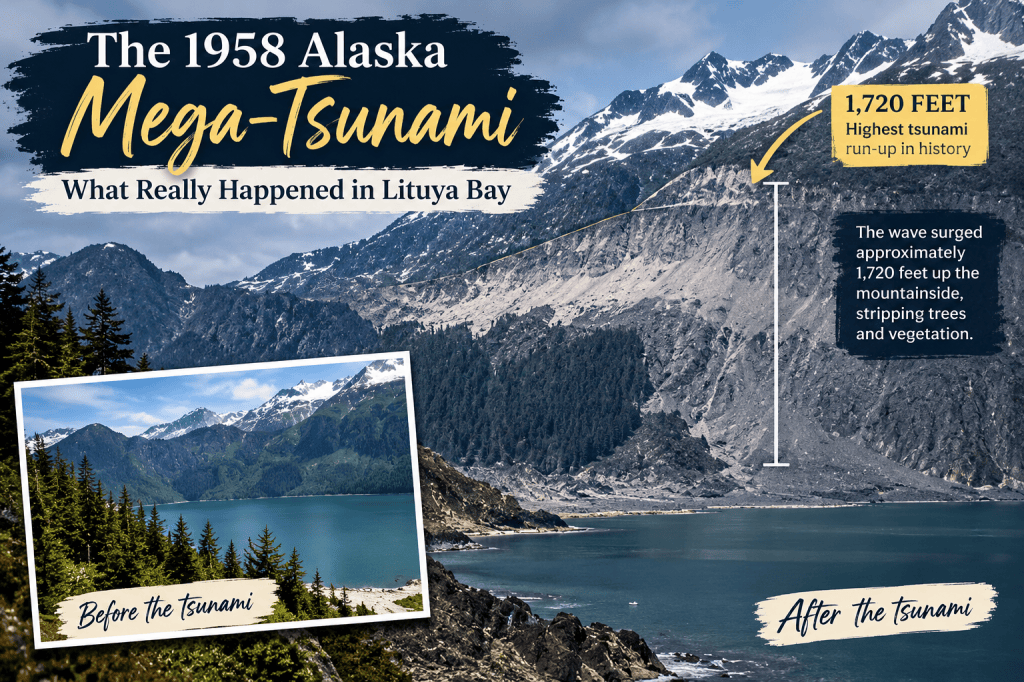
On July 9, 1958, a powerful earthquake triggered a landslide into Alaska’s Lituya Bay, producing the highest documented tsunami run-up in history.
Water reached approximately 1,720 feet up the surrounding mountainside.
Let that sink in for a second.
That’s taller than the Empire State Building!
But here’s the important detail: It wasn’t a 1,720-foot wall of water traveling across the Pacific Ocean. That measurement describes how high the water surged up the mountainside in a very specific location.
Still absolutely terrifying, but very different from what those dramatic headlines might make you imagine.
Wait… California Has Its Own Mega-Earthquake Threat?
Here’s where things get interesting.
Off the Pacific Northwest coast lies something called the Cascadia Subduction Zone.
It’s an enormous fault system stretching from Northern California to British Columbia.
And scientists know it’s capable of producing earthquakes around magnitude 9.
In fact, the last major Cascadia earthquake occurred in January 1700, generating a tsunami that traveled across the Pacific Ocean and reached Japan.
Think about that.
This happened long before smartphones, emergency alerts, or modern earthquake monitoring.
And the geological evidence is still there.
Scientists study these ancient events to understand what could happen again.
Not necessarily tomorrow. Not necessarily in our lifetime.
But someday.
And that’s the part that makes my curious little brain start spinning.
Then I Moved to California
When I eventually moved to Northern California, I remember bringing up that documentary to the man who would become my husband.
I was concerned about the possibility of a catastrophic tsunami.
He reassured me that we lived far enough inland that we wouldn’t have to worry about a tsunami reaching our home.
And thankfully, when it comes to direct tsunami flooding, he had a very good point.
We don’t live directly along the coastline.
But that doesn’t mean California is free from natural disasters.
We still have earthquakes, wildfires, and other hazards that come with living in such a geographically fascinating state.
And while I absolutely love living here, I would be lying if I said those possibilities never crossed my mind.
Because here’s the thing about nature.
It doesn’t operate on our schedules.
The One Thing I Didn’t Know About Tsunamis
My husband and I love exploring Northern California.
We’ve visited beautiful coastal destinations, walked along beaches, and explored historic lighthouses.
And surprisingly, I don’t usually think about tsunamis when I’m standing near the ocean.
Why?
Because I always assumed that if something catastrophic happened, we would receive a warning and have enough time to evacuate.
Turns out, that’s not always true.
If a tsunami originates thousands of miles away, coastal communities may have hours to prepare.
But if a major earthquake occurs just offshore, the first tsunami waves could arrive within minutes.
And that’s something I genuinely didn’t understand before looking into this.
If you’re near the coast and experience strong or prolonged earthquake shaking, you shouldn’t wait for a phone notification or official evacuation order.
You should immediately move to higher ground or farther inland.
The ocean also doesn’t always dramatically pull away from shore before a tsunami arrives, despite what movies sometimes show.
Sometimes the water simply begins rising and rushing inland.
That’s a pretty important piece of information for anyone who enjoys spending time near the ocean.
So, Should We Be Scared?
I don’t think living in fear is the answer.
And I certainly don’t plan on giving up my coastal adventures anytime soon.
I love California.
I love its rugged coastline, towering redwoods, historic towns, and beautiful landscapes.
But I also think there’s something valuable about understanding the natural forces that helped shape the places we love.
Earthquakes and tsunamis aren’t supernatural mysteries.
They’re real geological processes that scientists have spent decades studying.
And while we can’t predict exactly when the next major earthquake will occur, we can learn how to prepare.
Maybe that’s the lesson I took away from revisiting this subject.
Knowledge doesn’t have to make us fearful.
Sometimes it simply makes us better prepared.
Mother Nature Will Always Have the Final Word
I find nature absolutely fascinating.
It’s beautiful, powerful, unpredictable, and sometimes downright terrifying.
One minute you’re admiring the peaceful Pacific Ocean, and the next you’re reading about a wave that surged more than 1,700 feet up an Alaskan mountainside.
And suddenly, that ocean looks a little different.
But I refuse to let the possibility of something happening someday keep me from enjoying the world today.
I’ll still visit the beaches.
I’ll still explore the lighthouses.
I’ll still stand along the coastline, admiring the endless blue water and wondering about all the history hidden beneath its surface.
I’ll just have a little more respect for what that water is capable of.
And maybe I’ll pay closer attention to those tsunami evacuation signs along the way.
Now I’m curious…
Have you ever watched a documentary that scared you so much you still remember it years later?
And if you live somewhere prone to earthquakes, hurricanes, tornadoes, or other natural disasters, does it ever cross your mind?
Or do you simply accept that Mother Nature is going to do whatever Mother Nature wants?
Until next time, stay curious, stay prepared, and keep exploring.
— LexTalk
Want to learn more?
– “California Geological Survey — Tsunami Hazard Maps” (https://www.conservation.ca.gov/cgs/tsunami/maps)
– “NOAA — Tsunami Safety” (https://www.tsunami.gov/)
– “USGS — Earthquake Hazards Program” (https://www.usgs.gov/programs/earthquake-hazards)


Leave a Reply