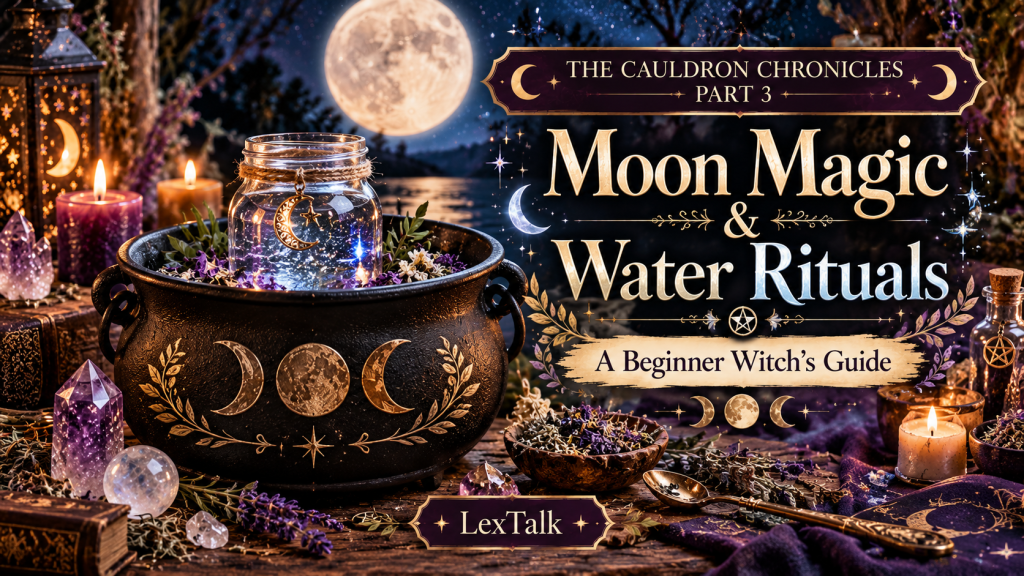
Moon Magic & Water Rituals — Harnessing Lunar Energy, Creating Moon Water & Exploring the Magic of the Moon
Welcome back to The Cauldron Chronicles on LexTalk!
We’ve explored herbal magic and potions, followed by fire magic and burning rituals. Today, we’re stepping into something a little softer, more mysterious, and honestly, something I’ve been excited to learn about.
Moon magic!
I’ve always been fascinated by the moon. There’s something magical about looking up at the night sky and seeing that beautiful glowing circle surrounded by darkness.
Sometimes it’s enormous and bright.
Sometimes it’s just a tiny crescent.
And sometimes we can’t see it at all.
But it’s always there.
Now that I finally have my very own cast-iron cauldron, I’ve been wondering how I can incorporate moon magic and water rituals into my spiritual practice.
What exactly is moon water?
Does it matter which phase the moon is in?
Can I leave water inside my cauldron overnight?
And what does the moon actually have to do with witchcraft?
Grab your favorite drink, get comfortable, and let’s explore!
 The Fascinating History of Moon Magic
Long before modern witchcraft existed, humans were fascinated by the moon.
Ancient civilizations observed its changing appearance, tracked lunar cycles, and incorporated the moon into religious traditions, mythology, and calendars.
And when you think about it, that makes perfect sense.
Imagine living thousands of years ago without electricity, streetlights, or the ability to check the moon phase on your phone.
The moon would have been one of the most noticeable features of the nighttime sky.
Its predictable changes provided a way to track the passage of time.
But it also inspired stories about gods, goddesses, creation, fertility, death, and renewal.
 Ancient Greece: Selene, Goddess of the Moon
In Greek mythology, Selene personified the moon.
She was frequently depicted traveling across the sky in a chariot.
One particularly fascinating myth involves Selene and Endymion, a beautiful mortal associated with eternal sleep.
The story became a popular subject in ancient Roman artwork.
In fact, [The Metropolitan Museum of Art](https://www.metmuseum.org/art/collection/search/254590?utm_source=chatgpt.com) has an early third-century Roman sarcophagus depicting Selene visiting Endymion.
I love that these stories have survived for so many centuries.
It’s a reminder that people have been looking toward the same moon and finding inspiration in it for thousands of years.
Chandra: The Moon in Hindu Traditions
In Hindu religious traditions, Chandra is associated with the moon.
Chandra appears in religious artwork and is connected with a larger system of celestial symbolism.
A beautiful historical example is a Nepalese mandala dating to the late 14th or early 15th century, preserved by [The Metropolitan Museum of Art](https://www.metmuseum.org/art/collection/search/38344?utm_source=chatgpt.com).
This artwork depicts Chandra among the nine planetary deities known as the Navagraha.
It’s important to remember that Hindu traditions are living religious practices, not simply historical inspiration for modern witchcraft.
Learning about these traditions helps me appreciate how differently cultures have understood the moon.
 Moon Magic in Modern Witchcraft
Today, lunar rituals are popular in contemporary Paganism, Wicca, and various forms of modern witchcraft.
Some practitioners celebrate full moons through gatherings, meditation, divination, or spiritual ceremonies.
Others work independently, incorporating moon phases into journaling, intention-setting, tarot readings, or personal rituals.
The important distinction is that not every modern practice has an ancient origin.
For example, the popular practice of making moon water shouldn’t automatically be described as an uninterrupted tradition dating back thousands of years.
Modern witchcraft includes both historical influences and newer spiritual customs.
And personally, I think understanding that difference makes exploring these practices even more interesting.
 Understanding the Eight Phases of the Moon
Before getting into rituals, I wanted to understand what actually happens during the lunar cycle.
According to [NASA’s guide to moon phases](https://science.nasa.gov/moon/moon-phases/?utm_source=chatgpt.com), the moon completes a cycle of phases approximately every 29.5 days.
The moon doesn’t produce its own light.
What we see is sunlight reflecting off its surface.
As the moon orbits Earth, our view of its illuminated portion changes.
That’s what creates the phases.
In modern witchcraft, practitioners often assign symbolic meanings to each phase.
These associations vary by tradition and personal belief.
Here’s a beginner-friendly breakdown.
Moon Phase Common Spiritual Symbolism Suggested Practice
 New Moon Beginnings, possibilities, reflection Set intentions
 Waxing Crescent Hope, growth, motivation Plan your next steps
 First Quarter Courage, decisions, action Work toward a goal
 Waxing Gibbous Preparation, refinement, patience Evaluate progress
Full Moon Illumination, gratitude, completion Reflect and celebrate
 Waning Gibbous Appreciation, sharing, understanding Practice gratitude
 Last Quarter Release, boundaries, reassessment Let go of unhelpful habits
Waning Crescent Rest, closure, restoration Journal and recharge
What I find interesting is how these symbolic meanings can mirror different stages of our lives.
Sometimes we’re starting something new.
Sometimes we’re working toward a goal.
Sometimes we’re celebrating an accomplishment.
And sometimes we need to rest.
The moon provides a beautiful reminder that life moves through cycles.
Not every phase is about growing. Sometimes it’s about resting, reflecting, or releasing.
 What Exactly Is Moon Water?
Now we’re getting to something I’ve seen discussed frequently in witchcraft communities.
Moon water!
Moon water is generally water that a practitioner places somewhere associated with moonlight or the nighttime sky while setting a spiritual intention.
In contemporary witchcraft, some people believe the water symbolically absorbs or carries lunar energy.
Others treat the process as a mindful ritual rather than a supernatural transformation.
There isn’t scientific evidence that placing water beneath the moon gives it special magical properties.
But that doesn’t mean someone can’t find personal meaning in the practice.
I actually love the simplicity of it.
Water.
A container.
The moon.
And an intention.
That’s it!
No elaborate equipment.
No expensive ingredients.
And no complicated spell to memorize.
Does Moon Water Have to Be Made During a Full Moon?
No!
Although full moon water is especially popular, modern practitioners may create moon water during different lunar phases.
The symbolism simply changes.
For example, new moon water might represent fresh beginnings.
Waxing moon water might symbolize growth.
Full moon water could represent gratitude or illumination.
Waning moon water might be associated with release.
These are personal or tradition-specific correspondences rather than fixed rules.
You can also make a meaningful water ritual without waiting for a particular moon phase.
I think that’s important for beginners to remember.
Witchcraft doesn’t need to become another thing on our never-ending to-do lists.
How Can I Use Moon Water?
This is where the possibilities become interesting!
Moon water can be incorporated into several symbolic practices.
1. Intention-Setting Rituals
Place a sealed jar of water on your altar while reflecting on a goal.
You might associate the water with clarity, patience, or emotional renewal.
2. Tarot and Oracle Readings
Keep a closed container of moon water nearby during a reading.
It can serve as a reminder to slow down, reflect, and trust your judgment.
Water should never be poured onto tarot cards or other items that could be damaged.
3. Symbolic Cleansing
Some practitioners use moon water as part of spiritual cleansing ceremonies.
For a beginner, this might involve placing a sealed container near an altar while cleaning and organizing the space.
There’s no need to spray water on furniture, electronics, or delicate objects.
4. Journaling and Reflection
This might be one of my favorite ideas.
Create moon water during a particular lunar phase and use the ritual as an opportunity to write about what you’re experiencing.
Then revisit your journal during the next lunar cycle.
You could even track your progress over several months.
5. Seasonal Celebrations
Moon water can also be incorporated symbolically into seasonal altar displays.
A beautiful glass jar surrounded by celestial decorations would fit perfectly into a magical space.
Just remember that ritual water isn’t automatically safe to drink or apply to your skin.
If water has been left outdoors, contaminated, or mixed with herbs, crystals, oils, or other ingredients, treat it as decorative ritual water only.
 Can I Make Moon Water in My Cast-Iron Cauldron?
Here’s the question I’ve been waiting to answer!
I absolutely love my new cauldron.
And I want to use it.
But I also want it to last for years.
Unfortunately, leaving water sitting directly inside a seasoned cast-iron cauldron overnight isn’t a good idea.
Cast iron is susceptible to rust when exposed to prolonged moisture.
The protective seasoning layer helps, but it doesn’t make the vessel completely waterproof.
According to [Lodge Cast Iron’s cleaning instructions](https://www.lodgecastiron.com/pages/how-to-clean?utm_source=chatgpt.com), cast iron shouldn’t be left soaking in water.
The manufacturer recommends washing, drying thoroughly, and applying a very thin layer of oil when appropriate.
So here’s my solution.
Use the cauldron as a symbolic holder for a separate sealed glass container!
That way, I can incorporate my cauldron into the ritual without filling it directly with water.
And honestly?
I think a beautiful glass jar resting inside a black cast-iron cauldron would look absolutely magical.
Just make sure the jar fits securely and the cauldron remains unheated.
If your cauldron is decorative rather than manufactured as cookware, follow its specific care instructions instead of assuming ordinary cast-iron cookware guidance applies.
Beginner Ritual: Making Moon Water With My Cauldron
For my first moon water ritual, I want something peaceful, meaningful, and easy to repeat.
Nothing complicated.
Nothing dangerous.
Just a quiet moment to connect with my intentions.
 Supplies Needed
– My cast-iron cauldron
– A clean glass jar with a secure lid
– Fresh water
– A journal
– A pen
– A battery-operated candle
– Optional tarot or oracle cards
– A stable, pet-safe altar space
I won’t be adding crystals, essential oils, or loose herbs to the water.
That keeps the ritual simple and avoids unnecessary contamination or pet hazards.
Step 1: Choose My Intention
Before beginning, I’ll think about what I want this particular ritual to represent.
Maybe it’s clarity.
Maybe it’s gratitude.
Or perhaps it’s finding the confidence to trust myself more.
I especially like that last one.
I’ve been learning to trust my intuition and pay closer attention to how situations make me feel.
So for this ritual, my intention might be:
I trust myself to recognize what feels right for me.
Step 2: Prepare the Water
I’ll fill my clean glass jar with fresh water and secure the lid.
Then I’ll place the jar inside my dry, unheated cauldron.
The water remains inside the glass.
The cauldron serves as a symbolic vessel.
No soaking.
No rust.
And no unnecessary damage to the seasoning.
Step 3: Create a Peaceful Atmosphere
I’ll find a quiet location near a window where I can appreciate the nighttime sky.
If the moon is visible, wonderful!
If it’s cloudy, that’s fine too.
The purpose of this ritual is personal reflection.
The moon doesn’t need to be directly visible for the experience to feel meaningful.
I’ll turn on my battery-operated candle and take a few slow breaths.
Step 4: Set My Intention
I’ll place my hands near the cauldron and focus on the words I’ve chosen.
For example:
Beneath the changing moon, I welcome clarity.
Like water, I allow myself to move and grow.
I release unnecessary doubt.
I trust my intuition.
And I welcome peace into my life.
I love the idea of creating simple words that feel personal rather than trying to memorize something complicated.
Step 5: Reflect
I’ll spend a few minutes thinking about my intention.
What does trusting myself actually look like?
Does it mean setting stronger boundaries?
Does it mean worrying less about other people’s opinions?
Or does it mean giving myself permission to make decisions without constantly questioning them?
This is where I think rituals can become genuinely useful.
They encourage us to reflect on what we want and how we might move toward it.
Step 6: Close the Ritual
After a few minutes, I’ll write down my intention in my journal.
Then I’ll remove the sealed jar from the cauldron.
I can keep the jar in a secure place as a temporary symbolic reminder, but I won’t leave it sitting around indefinitely.
For this beginner ritual, the water can be discarded afterward.
There’s no need to store it for weeks or months.
The meaning comes from the experience, not from preserving the water.
 Other Water Rituals Worth Exploring
Moon water is only one way to incorporate water symbolism into spiritual practices.
Water has been associated with purification, renewal, healing, and transition in numerous religious and cultural traditions.
But those traditions have distinct histories and meanings.
A modern witchcraft ritual shouldn’t automatically be equated with a religious purification ceremony from another culture.
With that distinction in mind, here are a few contemporary practices I find interesting.
Water Meditation
This one is incredibly simple.
Place a bowl of water in front of you.
Watch the surface.
Notice how it responds to movement.
Think about the difference between stillness and disturbance.
I like the idea of using water as a reminder that emotions change.
Sometimes life feels calm.
Sometimes everything feels chaotic.
But neither state lasts forever.
 Rainwater Symbolism
Rain is frequently associated with renewal and cleansing in contemporary spiritual practices.
Some practitioners collect rainwater for symbolic rituals.
However, collected rainwater can contain microorganisms, environmental pollutants, and debris.
It shouldn’t automatically be considered safe for drinking, bathing, or applying to the skin.
For my own practice, I would rather observe the rain and use clean water indoors for any symbolic ritual.
Sometimes the atmosphere is enough.
 Water Scrying
This is another practice I’m excited to explore more deeply later in the series.
Scrying involves gazing into a reflective surface as part of a divination or meditative practice.
Some people use mirrors.
Others use dark bowls of water.
The purpose may be to reflect on images, thoughts, or impressions that arise.
There isn’t scientific evidence that scrying reveals supernatural information, but it can be approached as a contemplative exercise.
We’ll explore this more in Part 6, when we dive into divination, tarot, and scrying.
Does the Moon Really Affect Our Energy?
This is something I’ve wondered about.
The moon absolutely influences physical processes on Earth.
One of the most recognizable examples is ocean tides.
The gravitational interactions between Earth, the moon, and the sun contribute to changing sea levels.
But what about our emotions?
Our intuition?
Our personal energy?
There are plenty of popular claims suggesting that full moons cause unusual behavior, emotional changes, or increased supernatural activity.
However, scientific research hasn’t established a consistent, reliable connection between lunar phases and those claims.
The moon’s measurable influence on tides doesn’t mean it controls human emotions or gives water magical properties.
Personally, I think it’s possible to appreciate the moon’s spiritual symbolism without treating every traditional belief as scientific fact.
I can enjoy moon rituals because they encourage reflection.
I can appreciate the mythology.
And I can still recognize what science has—and hasn’t—demonstrated.
To me, curiosity means being willing to explore both.
 Moon Magic, Water Rituals & Keeping Juggy Safe
Of course, we need to talk about my favorite little feline companion.
Juggy!
Because let’s be realistic.
If I leave an interesting jar, bowl, or decorative object somewhere, there’s a good chance he’ll want to investigate.
And the last thing I need is a magical moon water ritual turning into a spilled-water situation.
So, I’m establishing a few rules.
First, no unattended open containers. I don’t want Juggy drinking ritual water or knocking anything over.
Second, no essential oils. Concentrated essential oils can be harmful to cats, particularly through ingestion or direct contact. The [ASPCA’s essential oil safety guidance](https://www.aspca.org/news/essentials-essential-oils-around-pets?utm_source=chatgpt.com) explains why caution is important.
Third, no questionable herbs or flowers. Just because something is natural doesn’t mean it’s safe for animals.
Fourth, no loose crystals or tiny decorations within reach. I don’t want him swallowing anything or getting injured.
And finally, no open flames.
I love candles, but battery-operated versions make much more sense when I’m creating a ritual space around a curious cat.
Juggy’s safety comes before aesthetics.
Always.
 Moon Water & Cauldron Safety: What Beginners Should Know
There are a few important precautions I want to remember.
Protect the Cast-Iron Seasoning
Cast-iron seasoning is a protective layer created when oil bonds to the metal through heating.
Don’t leave water directly inside a seasoned cauldron overnight.
If the vessel becomes wet, dry it thoroughly.
For cookware-grade cast iron, follow the manufacturer’s recommendations for cleaning and maintaining its seasoning.
Don’t Drink Questionable Moon Water
Water left outdoors can become contaminated.
Moonlight doesn’t disinfect water.
If you want drinking water, use fresh potable water from a clean, food-safe container.
Don’t drink ritual water that has been exposed to outdoor conditions or mixed with non-food ingredients.
The [CDC’s safe water storage guidance](https://www.cdc.gov/global-water-sanitation-hygiene/about/about-safe-water-storage.html?utm_source=chatgpt.com) emphasizes using clean, covered containers to help prevent contamination.
Avoid Adding Crystals Directly to Water
Some minerals can dissolve, shed particles, or contain potentially harmful substances.
Unless a material’s composition and safety are known, don’t immerse it in water intended for human or animal contact.
Keep Fire Separate From Water Rituals
A battery-operated candle is sufficient for creating atmosphere.
If you choose to use a real candle, the [U.S. Fire Administration](https://www.usfa.fema.gov/prevention/home-fires/prevent-fires/candle/?utm_source=chatgpt.com) recommends keeping it at least 12 inches away from combustible materials, using a stable holder, and never leaving it unattended.
Never heat a sealed glass jar or place it in a burning cauldron.
Protect Children and Pets
Keep glass containers, water, decorations, and ritual materials in secure locations.
Clean spills immediately.
And don’t leave a ritual setup unattended where it could be knocked over.
The safest ritual is one that allows you to enjoy the experience without worrying about accidents.
What Moon Magic Is Teaching Me
One of the things I’m enjoying most about this series is discovering that witchcraft doesn’t always require elaborate spells or complicated equipment.
Sometimes it’s as simple as sitting quietly.
Watching the moon.
Writing in a journal.
Or taking a few moments to think about what you want from life.
I’m someone who loves setting goals.
And once I accomplish something, I’m usually already thinking about the next thing I want to achieve.
Sometimes I forget to slow down and appreciate the progress I’ve made.
That’s why the symbolism of the moon resonates with me.
Every phase serves a purpose.
The new moon isn’t somehow less important than the full moon.
The waning moon isn’t failing because its illuminated portion appears to be shrinking.
It’s simply moving through its cycle.
And maybe that’s something we can learn from.
We don’t have to be growing, achieving, or accomplishing something every single day.
Sometimes we need to rest.
Sometimes we need to reflect.
And sometimes we need to appreciate where we are before deciding where we’re going next.
I think that’s a beautiful lesson.
My Cauldron Chronicles Journey So Far
When I purchased my cast-iron cauldron, I knew I wanted it for my altar and spiritual practice.
I’d wanted one for such a long time.
And now that I finally have it, I’m discovering how many different ways I can incorporate it into meaningful rituals.
In Part 1, we explored herbs and their symbolic associations.
In Part 2, we explored fire, transformation, and release.
And now, in Part 3, we’re exploring water, reflection, and the changing moon.
Each practice offers something different.
But I’m noticing a common theme.
Intention.
It’s not necessarily about having the most beautiful altar.
Or owning every crystal.
Or knowing every spell.
It’s about understanding what you’re doing and why it matters to you.
And honestly, that’s exactly what I hoped to discover when I started this series.
Coming Next: Protection, Banishing & Cleansing Magic
Our next installment is going to explore another fascinating area of witchcraft.
Protection, Banishing & Cleansing!
We’ll discuss the history and symbolism of protective practices, common beginner tools, personal boundaries, and ways to incorporate protection symbolism into cauldron rituals.
I’m especially interested in exploring the difference between spiritual protection and practical emotional boundaries.
Because sometimes protecting your peace is less about performing a ritual and more about deciding what you’re willing to allow into your life.
And I think that’s a conversation worth having.
Let’s Talk!
Have you ever made moon water?
Do you follow the phases of the moon when setting intentions?
Are you more drawn to the new moon, full moon, or waning moon?
And if you’re a fellow beginner witch, what’s one lunar ritual you’ve been curious about trying?
I’d love to hear about your experiences!
Until next time, stay curious, embrace the mysterious, and remember to find a little magic in the everyday.
With love and a little magic,
LexTalk


Leave a Reply