Have you ever finally sat down on the couch, gotten comfortable, and thought:
Ahhh. Finally. I’m going to relax.
And then approximately three seconds later your brain goes:
DID YOU SWITCH THE LAUNDRY?
What about those emails?
Shouldn’t you work on that thing you’ve been putting off?
Did you answer that message?
The kitchen could probably use cleaning.
You could get ahead on tomorrow’s work…
OH MY GOD.
CAN WE JUST SIT HERE FOR FIVE MINUTES?
If you’ve ever technically been resting while your brain continued running around like an unsupervised toddler, today’s tarot card might feel particularly relatable.
Welcome back to LexTalk Tarot: One Card at a Time, where I’m slowly making my way through all 78 tarot cards, learning the traditional meanings, studying the symbolism in the artwork, and hopefully making tarot a little easier to understand for anyone learning alongside me. 

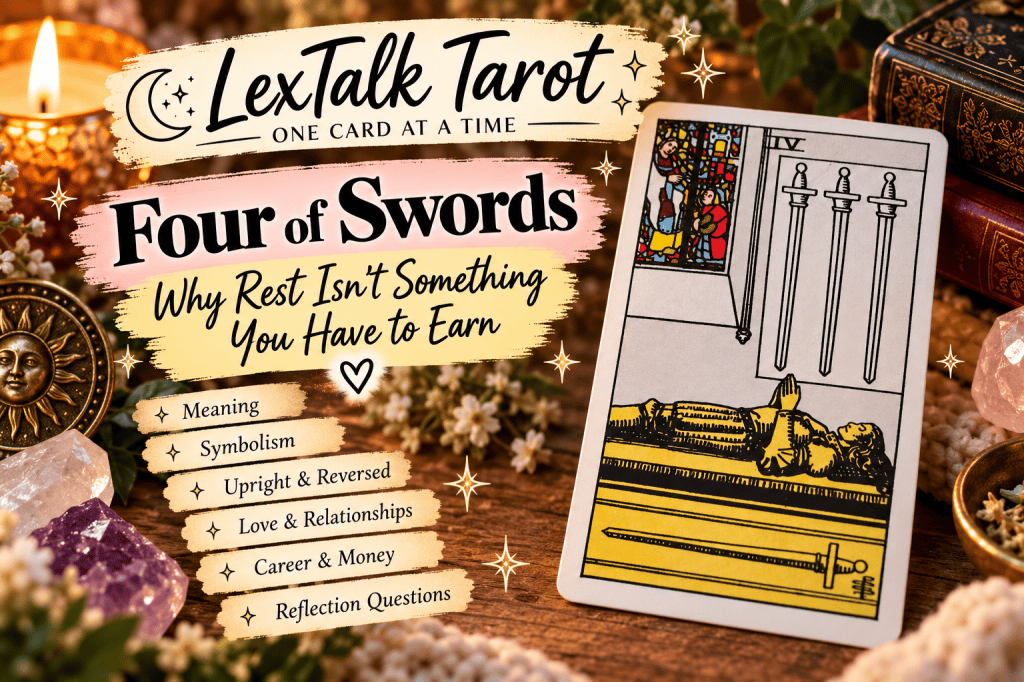
Today we’re studying the Four of Swords.
And unlike some of the cards we’ve explored recently, this one isn’t asking us to begin something.
It isn’t asking us to work harder.
It isn’t asking us to prove how strong we are.
Actually?
It might be asking us to do the exact opposite.
What if you’re allowed to rest before everything is finished?
 Meet the Four of Swords
The Four of Swords belongs to the Minor Arcana and, unsurprisingly, the Suit of Swords.
Swords are traditionally associated with the element of Air and connect with themes involving our thoughts, communication, decisions, conflict, truth, and mental activity.
Basically?
The stuff happening inside our heads.
And if your head occasionally has 14 tabs open, three are frozen, one is playing music and you have absolutely no idea where it’s coming from…
Welcome.
The Four of Swords brings a much quieter energy to the suit.
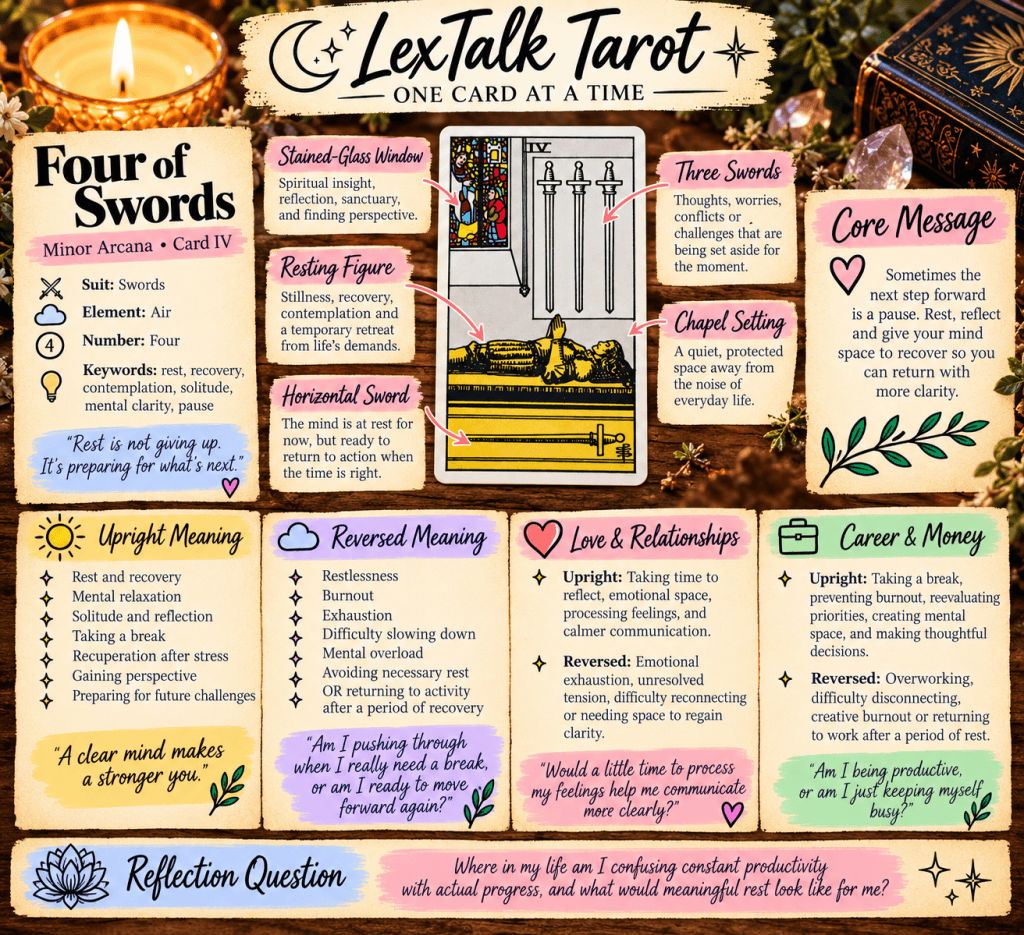
Its traditional themes include:
Rest • Recovery • Contemplation • Solitude • Mental clarity • Recuperation • Pause
And there’s something important about that last word.
Pause.
Not quit.
Not give up.
Not abandon everything you’ve been working toward.
Pause.
Because sometimes stepping away from something is exactly what allows us to come back to it with a clearer mind.
 Why Swords?
This is one of those cards where understanding the suit makes the meaning easier to remember.
Swords are connected with the mind.
Thoughts.
Decisions.
Communication.
Worries.
Conflict.
Analysis.
And occasionally…
over-analysis.
Hi. Hello. It’s me.
So when we get to the Four of Swords, we’re essentially being shown a mind that needs some quiet.
You can’t endlessly analyze.
Solve.
Plan.
Respond.
Research.
Worry.
Reevaluate.
And expect your brain to operate at full capacity forever.
Eventually, something needs to shut down for maintenance.
Preferably before we reach the point where someone asks a perfectly normal question and we respond internally with:
WHY IS EVERYONE ASKING SO MUCH OF ME?!
That’s usually a pretty good clue.
 The Symbolism of the Four of Swords
This is another card where I think studying the traditional Rider-Waite-Smith artwork makes the meaning MUCH easier to remember.
At first glance, the image might seem a little… ominous.
There’s someone lying on what appears to be a tomb.
Inside what looks like a chapel.
With swords hanging over them.
Wonderful.
Very relaxing.
But traditionally, the Four of Swords isn’t read as a literal prediction of death.
The imagery instead centers around stillness, retreat, contemplation, and recovery.
Let’s look closer.
The Three Swords on the Wall
Three swords hang vertically above the resting figure.
Swords represent the mental realm, so these can remind us of thoughts, worries, conflicts, or challenges.
But notice something important.
Nobody is holding them.
Nobody is fighting with them.
They’re simply hanging there.
And I love that visual.
Because sometimes we don’t need to solve every problem immediately.
Sometimes we can acknowledge:
Yes, this exists.
Yes, I need to deal with it.
No, I don’t need to deal with it at 11:47 tonight while lying in bed.
The problems haven’t disappeared.
We’re simply allowing ourselves to stop engaging with them for a moment.
 The Fourth Sword
The fourth sword lies horizontally along the side of the resting figure.
Some interpretations see this sword as representing the ability to return to action when needed.
The sword is available.
It hasn’t disappeared.
But right now?
It isn’t being used.
And I think that’s an incredibly helpful way to think about this card.
Rest doesn’t mean you’ve lost your ambition.
Rest doesn’t mean you’ve stopped caring.
Rest doesn’t mean you’re incapable of continuing.
The sword is still there.
You can pick it back up when you’re ready.
 The Resting Figure
The central figure lies peacefully with hands together in a prayer-like position.
There’s no movement.
No urgency.
No battle.
No attempt to accomplish something.
Just stillness.
And somehow, in a world where we’re constantly encouraged to do more, accomplish more, earn more, post more, clean more, organize more, exercise more, and somehow drink enough water while doing all of it…
Stillness can feel strangely uncomfortable.
Because the second we stop, we sometimes start thinking:
Shouldn’t I be doing something?
The Four of Swords gently asks:
Why doesn’t resting count as doing something?
 The Stained-Glass Window
There’s also a stained-glass window in the traditional artwork.
It adds to the quiet, sanctuary-like feeling of the scene.
The window can be associated with reflection, comfort, spiritual contemplation, and perspective.
And I think there’s something beautiful about the idea of finding a little sanctuary from our own mental noise.
That doesn’t necessarily require going anywhere special.
Your sanctuary might be:
A quiet bedroom.
A bathtub.
Your backyard.
A walking trail.
Your favorite chair.
A cup of coffee before everyone else wakes up.
Or approximately 20 minutes where nobody asks you a single question.
Whatever it looks like, sometimes we need somewhere our minds can become quiet.
 The Chapel Setting
The overall setting appears removed from everyday activity.
It’s peaceful.
Protected.
Still.
And that reinforces one of the biggest lessons in this card:
Sometimes clarity requires distance from the noise.
Have you ever been trying SO hard to solve something that you finally gave up, walked away…
and then the answer came to you later?
There’s a reason for that.
Sometimes constantly staring at a problem doesn’t make us better at solving it.
Sometimes our brains need room.
 Four of Swords Upright Meaning
When the Four of Swords appears upright, common interpretations include:
Rest • Recovery • Reflection • Solitude • Recuperation • Mental relaxation • Taking a break
This card can encourage us to recognize when we need to temporarily step away.
Maybe you’ve been working nonstop.
Maybe you’ve been dealing with conflict.
Maybe you’ve had a lot on your mind.
Maybe you’re trying to juggle work, family, relationships, responsibilities, hobbies, creative projects, finances, social media, errands…
…and somehow you’re also supposed to get eight hours of sleep.
Sure.
The Four of Swords doesn’t necessarily say:
STOP EVERYTHING AND DISAPPEAR FOR THREE MONTHS.
Although I’m sure some of us wouldn’t complain.
It can be much smaller than that.
Maybe you need an evening without working.
Maybe you need to put your phone away.
Maybe you need to take a walk without turning it into a workout.
Maybe you need to watch something ridiculous on television.
Maybe you need a nap.
Maybe you need to stop thinking about one particular problem until tomorrow.
Rest doesn’t have to be dramatic to be valuable.
 Four of Swords Reversed Meaning
And here comes our regular LexTalk Tarot reminder:
Reversed does not automatically mean BAD.
The Four of Swords reversed can actually point in a couple of different directions depending on the context.
It can represent:
Restlessness • Burnout • Exhaustion • Difficulty slowing down • Mental overload
But it can also represent:
Returning to activity • Rejoining the world • Feeling ready to move forward after a period of rest
That’s why context matters so much in tarot.
Imagine someone who’s been pushing themselves nonstop.
For them, the reversed Four of Swords might ask:
Why won’t you let yourself stop?
But imagine someone who’s been resting, recovering, or taking time away.
For them, it might ask:
Are you beginning to feel ready to move again?
Same card.
Different situation.
And that’s one of the things I’m starting to appreciate about learning tarot.
These cards aren’t necessarily rigid definitions.
They’re invitations to look at what’s actually happening.
 Four of Swords in Love & Relationships
In love and relationship readings, the Four of Swords can connect with reflection, emotional space, processing feelings, and temporarily stepping away from conflict.
And let’s be clear:
Taking a little time to process your feelings is NOT the same thing as giving someone the silent treatment.
There’s an enormous difference between:
“I need a little time to calm down so we can talk about this productively.”
and
“I’m going to ignore you until you suffer enough.”
One is communication.
The other is punishment.
Upright, the Four of Swords might encourage you to slow down before responding.
Maybe you don’t need to solve the disagreement immediately.
Maybe everybody involved would benefit from sleeping on it.
Reversed, the card can point toward emotional exhaustion, unresolved tension, difficulty reconnecting, or being ready to revisit something after taking space.
A helpful question might be:
Would giving myself time to process my feelings help me communicate them more clearly?
Because sometimes the conversation isn’t the problem.
The timing is.
 Four of Swords in Career & Money
Ohhh, this card and work.
We need to talk.
If you’re someone who works from home, runs a side hustle, creates content, manages a household, or does any combination of those things, you’ve probably discovered something interesting:
There is ALWAYS something else you could be doing.
Always.
You could answer another email.
Write another post.
Make another pin.
Clean something.
Research something.
Schedule something.
Organize something.
And because the work is never technically “finished,” it becomes incredibly easy to feel like you haven’t earned the right to stop.
The Four of Swords challenges that.
In career readings, this card can represent taking a break, preventing burnout, reevaluating priorities, creating mental space, or temporarily stepping away so you can return with greater focus.
Reversed, it can point toward overworking, burnout, difficulty disconnecting, or returning to work after a period of rest.
And here’s a question I think is worth asking:
Am I actually being productive…or am I just keeping myself busy?
Because those aren’t always the same thing.
Ouch.
 Four of Swords & Money
When it comes to money, the Four of Swords isn’t a promise that money is coming or a warning that money is disappearing.
Instead, I think its energy works beautifully as a reminder to:
Pause.
Review.
Think.
Avoid making major financial decisions while panicked, overwhelmed, or emotionally exhausted.
Sometimes we feel like we need to fix everything immediately.
But important decisions usually benefit from a clear head.
Tarot should never replace actual financial advice or research.
But it can give us a useful question:
Would I make the same decision if I weren’t feeling stressed right now?
That’s worth considering.
Why Do We Feel Like We Have to Earn Rest?
This is the part of the Four of Swords that really sticks with me.
Why do we treat rest like a prize?
We tell ourselves:
I’ll sit down after I finish everything.
I’ll watch the movie after the house is clean.
I’ll relax after the emails are answered.
I’ll take the day off when I’m caught up.
But here’s the problem:
When are we ever completely caught up?
There’s always another load of laundry.
Another email.
Another bill.
Another project.
Another appointment.
Another thing that could technically be done.
If rest requires completing absolutely everything first…
We’re never going to rest.
And maybe that’s exactly what the Four of Swords is trying to teach us.
Rest isn’t always the reward at the end of productivity.
Sometimes rest is what allows us to remain productive in the first place.
 Rest Doesn’t Always Mean Sleeping
I think this is worth mentioning too.
Rest can look different depending on what you’re exhausted from.
Sometimes you need sleep.
But sometimes you’re not physically tired.
You’re mentally tired.
Maybe rest looks like:
Reading something just because you enjoy it.
Taking a walk.
Sitting outside.
Watching a comfort show.
Taking a bath.
Listening to music.
Coloring.
Journaling.
Pulling an oracle card.
Drinking coffee without doing three other things at the same time.
Or simply sitting somewhere quiet.
The goal isn’t necessarily:
DO ABSOLUTELY NOTHING.
It’s giving your brain a break from constantly needing to perform.
 Today’s LexTalk Tarot Reflection
Today’s main reflection question is:
Where in my life am I confusing constant productivity with actual progress?
And here’s another:
What would meaningful rest look like for me right now?
Not what Instagram says self-care should look like.
Not what someone else finds relaxing.
What actually helps you feel restored?
And finally:
What’s one responsibility, worry, or expectation I could temporarily set down?
You don’t have to throw it away.
Remember the fourth sword.
It’s still there.
You can pick it back up later.
The Tarot Deck I’m Learning With
If you’ve been following LexTalk Tarot: One Card at a Time, I’m now using a physical Rider-Waite-Smith tarot deck throughout the series so we can actually look at the traditional artwork while we’re learning.
And honestly?
Having the physical cards in front of me has made studying them SO much easier.
Instead of trying to memorize:
Four of Swords = rest.
I can look at the resting figure.
The hanging swords.
The stained-glass window.
The quiet setting.
Suddenly, there’s a story attached to the meaning.
If you’d like to learn with the same style of deck I’m using, you can [check out the tarot deck I’m using here — paid link].
You absolutely don’t need the exact same deck to follow along, but I love being able to study the traditional imagery together.
As an Amazon Associate, I earn from qualifying purchases.
 My Tarot Journal Is Becoming Very Necessary
We’re getting further into this series now, and I can officially confirm something:
There is NO WAY I’m remembering every single detail without writing some of this down.
There are 78 cards.
Upright meanings.
Reversed meanings.
Numbers.
Elements.
Symbols.
Astrological associations.
And apparently every flower, mountain, hand position, tiny dog, sword, window, and random background object deserves our attention.
I love it.
But my brain has limits.
I’ve been using journaling as a way to record the symbols and meanings that stand out to me instead of trying to memorize everything at once.
If you’re learning alongside me, any notebook works perfectly.
But if you’d like something specifically for your tarot studies, you can [check out the tarot journal I found here — paid link].
The part I’m most excited about is eventually flipping back through these pages and seeing how much easier the cards become to recognize.
As an Amazon Associate, I earn from qualifying purchases.
Eight Cards Into LexTalk Tarot!
Okay…
We’re officially EIGHT cards into this adventure.
And naturally, I have to see what our little collection is teaching us.
The High Priestess
Trust yourself.
Listen to your intuition.
 Ace of Pentacles
Plant the seed.
Something meaningful can begin incredibly small.
 Page of Cups
Stay curious.
That weird idea might actually be worth exploring.
 The Fool
Begin.
You don’t have to know the entire journey before taking the first step.
 Eight of Pentacles
Practice.
Learning takes repetition, patience, and time.
 The Magician
Use what you have.
You might already possess more tools and abilities than you realize.
 Strength
Choose how you use your power.
Courage doesn’t always need to roar.
Four of Swords
Rest.
You don’t have to earn permission to recharge.
And when we put all eight together?
Trust yourself. Plant something. Stay curious. Begin. Practice. Use what you have. Know your strength. And REST when you need to.
Okay, tarot.
I see what you’re doing here.
Learning the Four of Swords One Symbol at a Time
If you’re learning tarot alongside me, I don’t want you leaving this post thinking:
Wonderful. Lex just gave me another 47 things to memorize.
Nope.
We’re keeping this simple.
Today?
Remember the resting figure.
When you see the Four of Swords, think:
Rest.
Recovery.
Pause.
Reflection.
Mental clarity.
The swords are still there.
The challenges haven’t magically disappeared.
But nobody is fighting them right now.
And that’s your memory trick.
Four of Swords = I can put the sword down without giving up the fight.
You can rest and still be ambitious.
You can take a break and still be hardworking.
You can slow down without falling behind.
And maybe — just maybe — you don’t need to finish every single thing on your to-do list before you’re allowed to sit down.
The laundry will survive.
The email can probably wait.
The world will continue spinning.
And whatever you’re working toward?
It might actually benefit from meeting the version of you who got some rest first.
Now, please excuse me while I attempt to follow my own advice.
One card. One lesson. One little bit of magic at a time.
— Lex
Tarot interpretations are subjective and are shared here for personal reflection, education, and entertainment. Tarot should not replace professional medical, legal, mental health, or financial advice.


Leave a Reply