Have you ever heard a song you haven’t listened to in twenty years and somehow remembered EVERY. SINGLE. WORD?
Meanwhile, you walked into the kitchen five minutes ago and have absolutely no idea why you’re standing there.
Memory is such a strange thing.
A familiar smell can suddenly remind you of someone’s kitchen.
An old movie can transport you right back to the living room where you watched it as a kid.
A photograph can unlock a moment you hadn’t thought about in years.
A certain food can remind you of holidays.
A song can remind you of a person.
And sometimes, completely out of nowhere, a memory hits you so hard that for just a second…
you can almost feel like you’re there again.
Today’s tarot card is all about those connections.
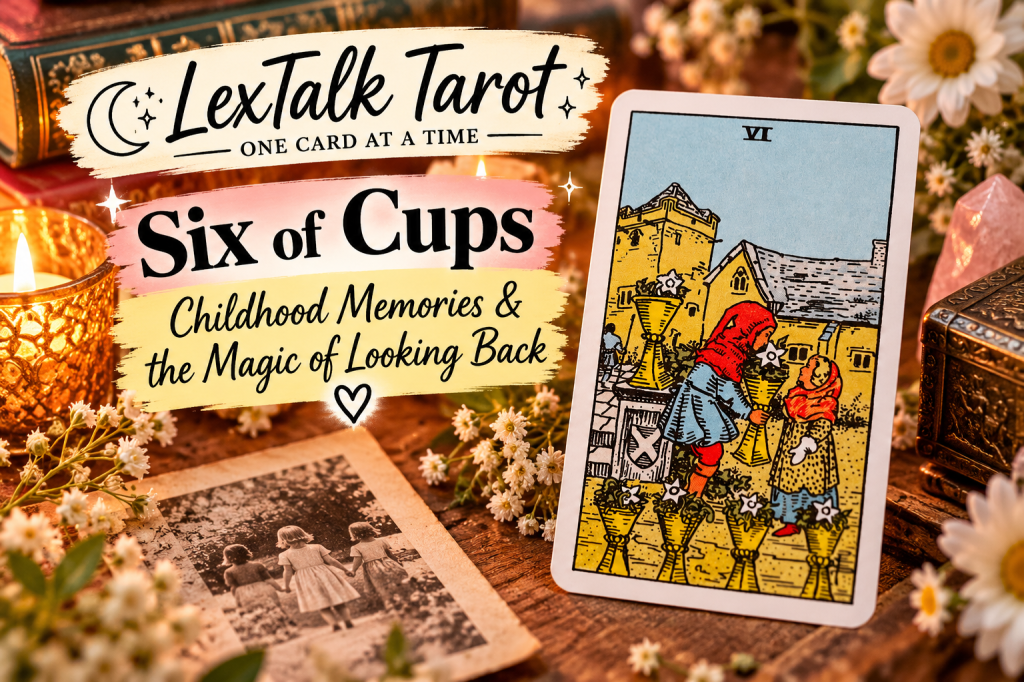
Welcome back to LexTalk Tarot: One Card at a Time, where I’m slowly making my way through all 78 tarot cards, studying the traditional Rider-Waite-Smith artwork, learning the symbolism hidden inside each card, and hopefully making tarot a little less intimidating for anyone learning alongside me. 

Today we’re studying the Six of Cups.
And this card has me thinking about childhood, memories, kindness, the people and places that helped shape us…
and the strange way the past can still show up in our present.
What if looking back isn’t always about wanting to go back?
Maybe sometimes it’s about remembering what mattered.
 Meet the Six of Cups
The Six of Cups belongs to the Minor Arcana and the Suit of Cups.
Cups are traditionally associated with the element of Water and themes involving:
Emotions • Relationships • Intuition • Connection • Love • Feelings
And today’s card adds another emotional layer:
Memory.
Traditional themes associated with the Six of Cups include:
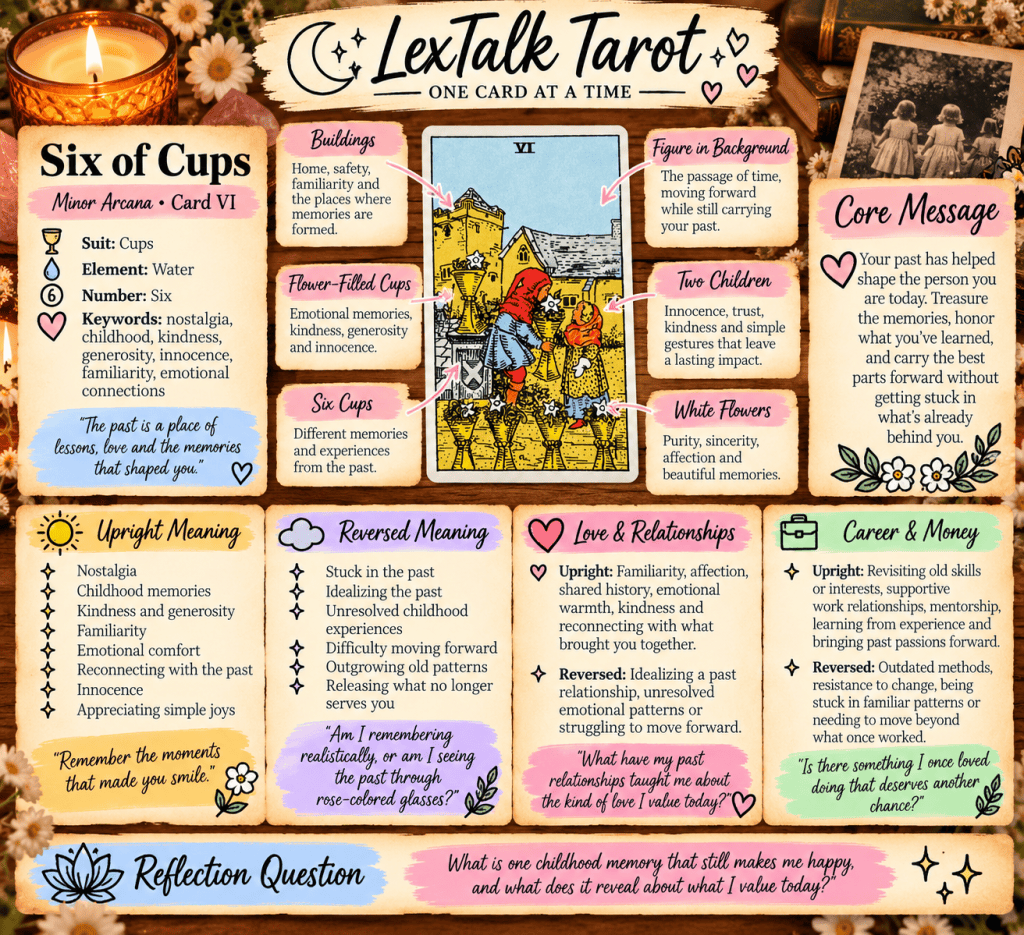
Nostalgia • Childhood • Memories • Kindness • Generosity • Innocence • Familiarity • Emotional connections
At first glance, this card feels incredibly sweet.
There are children.
Flowers.
Golden cups.
A quiet little village scene.
Compared with some tarot cards, nothing here immediately screams:
OH GOD, WHAT DOES THAT MEAN?!
But I think there’s actually a lot happening beneath the surface.
Because nostalgia is complicated.
Sometimes remembering the past feels wonderful.
Sometimes it’s bittersweet.
Sometimes we miss a person.
Sometimes we miss a place.
And sometimes?
We don’t necessarily miss what happened.
We miss who we were when it happened.
That’s what makes this card so interesting.
The Six Flower-Filled Cups
Obviously, we need to start with the cups.
There are six of them, and each is filled with white flowers.
Because we’re in the Suit of Cups, we’re already dealing with emotional experiences.
But these aren’t empty cups.
They’re overflowing with something beautiful.
The flowers contribute themes of innocence, affection, sincerity, simplicity, and kindness.
And here’s my beginner memory trick:
Imagine each cup holding a memory.
One might contain a childhood tradition.
Another could hold a person you loved.
One could be a favorite place.
Another could contain a moment you didn’t realize was important until years later.
Suddenly, the Six of Cups becomes much easier to remember.
It’s like looking through an emotional photo album.
 The Two Children
The most noticeable part of the traditional Rider-Waite-Smith artwork is the interaction between two young figures.
One is offering a flower-filled cup to the other.
That simple gesture connects beautifully with the traditional themes of kindness, generosity, innocence, and affection.
And I think there’s something important about how simple the gesture is.
It isn’t extravagant.
Nobody hired a marching band.
Nobody rented a billboard.
Nobody posted:
LOOK HOW KIND I AM!!!
It’s just a small act of giving.
And honestly?
Some of the things we remember most about people are incredibly small.
Someone remembering your favorite snack.
A teacher who encouraged you.
A friend sitting with you when you were upset.
Someone making you laugh when you needed it.
A person showing up.
A hug.
A conversation.
A tiny moment that probably seemed insignificant to them…
but stayed with you.
The Six of Cups reminds me that kindness doesn’t have to be enormous to matter.
 The Buildings & Familiar Setting
The scene behind the children feels sheltered and familiar.
Buildings often bring associations with home, safety, belonging, community, and the places where our memories were formed.
And “home” can mean so many different things.
Maybe it’s the house where you grew up.
A grandparent’s home.
A neighborhood.
A school.
A cabin.
A vacation spot your family returned to every year.
Or maybe it’s not really a building at all.
Maybe “home” is connected to a person.
That’s one of the reasons nostalgia can be so powerful.
We’re not always missing a physical place.
Sometimes we’re missing the feeling we associate with it.
 The Figure Walking Away
There’s another detail that’s easy to overlook.
In the background, there’s a figure walking away.
Different readers interpret this detail in different ways, but I love viewing it as a reminder of the passage of time.
Life continues.
People grow.
Places change.
Relationships change.
We move.
We lose people.
We meet new people.
We become versions of ourselves our younger selves never could have imagined.
And yet…
those earlier chapters don’t disappear.
We carry pieces of them with us.
I think that’s one of the most beautiful lessons inside the Six of Cups.
You don’t have to physically return somewhere for that place to remain part of your story.
 The White Flowers
The white flowers are often associated with innocence, purity, sincere intentions, and simple affection.
And again, they reinforce that childhood quality.
When you’re little, happiness can be incredibly simple.
Playing outside.
A favorite movie.
A sleepover.
Getting ice cream.
Going somewhere special.
Christmas morning.
A birthday party.
Finding out you DON’T have school tomorrow.
Honestly, that last one still works as an adult.
But as we get older, life becomes complicated.
Bills.
Jobs.
Schedules.
Appointments.
Responsibilities.
Deadlines.
Laundry that apparently reproduces overnight.
Maybe part of the Six of Cups asks:
What simple things still make you happy?
Because growing up doesn’t mean we’re required to outgrow joy.
 Six of Cups Upright Meaning
When the Six of Cups appears upright, traditional interpretations can include:
Nostalgia • Childhood memories • Kindness • Generosity • Familiarity • Innocence • Emotional comfort • Reconnecting with the past
Maybe something recently reminded you of an earlier chapter of your life.
Maybe you’re reconnecting with someone.
Maybe you’ve rediscovered an old hobby.
Maybe you’re returning somewhere meaningful.
Or perhaps you’re simply reflecting on experiences that helped shape you.
The Six of Cups can encourage us to appreciate those memories.
But I think there’s an important distinction here.
Remembering the past isn’t necessarily the same thing as wanting it back.
You can miss a moment without wanting to recreate your entire life from that time.
You can appreciate someone who was once important without believing they still belong in your life today.
You can love a memory while recognizing that you’ve grown beyond the situation surrounding it.
That’s maturity.
And maybe that’s part of the lesson.
 Six of Cups Reversed Meaning
Here comes our regular LexTalk Tarot reminder:
Reversed doesn’t automatically mean BAD.
The Six of Cups reversed can connect with:
Being stuck in the past • Idealizing the past • Unresolved childhood experiences • Difficulty moving forward • Outgrowing old patterns • Releasing the past
And I think the idea of idealizing the past is particularly interesting.
Our memories aren’t perfect recordings.
Sometimes nostalgia edits things.
We remember the Christmas morning…
and forget the argument later that afternoon.
We remember the fun relationship…
and forget why it ended.
We remember how much easier childhood seemed…
while forgetting how desperately we wanted to grow up.
Funny how that works.
The reversed Six of Cups can invite us to ask whether we’re remembering something realistically.
But it can also represent growth.
Maybe you’re recognizing an old pattern.
Maybe you’re healing from something.
Maybe you’re realizing:
That’s part of my story, but it doesn’t have to control the next chapter.
And THAT feels powerful.
 Six of Cups in Love & Relationships
In love and relationship readings, the Six of Cups can connect with:
Familiarity • Affection • Shared history • Emotional comfort • Kindness • Nostalgia
For an established relationship, this card can encourage remembering the little things that brought you together.
The first dates.
Inside jokes.
Trips.
Songs.
Traditions.
Ridiculous stories that make absolutely no sense to anyone else.
Relationships change as life changes.
Jobs happen.
Kids happen.
Bills happen.
Responsibilities happen.
And sometimes it’s good to remember:
Oh yeah. I actually really LIKE this person.
Go somewhere you used to love.
Rewatch something you enjoyed together.
Look through old photos.
Recreate an early date.
Shared memories can be incredibly powerful.
Reversed, the Six of Cups can invite reflection on old relationship patterns, unresolved emotional baggage, or idealizing a past relationship.
And I want to emphasize something important:
The Six of Cups does NOT automatically mean your ex is coming back.
Tarot isn’t a guaranteed prediction system.
Instead, the card may simply invite you to reflect on what previous relationships taught you.
Ask:
What have my past relationships taught me about the kind of love I value today?
That’s far more useful than waiting for your phone to magically light up.
 Six of Cups in Career
The Six of Cups has a softer energy than some of the career cards we’ve explored.
Instead of shouting:
GO! BUILD! CREATE! ACHIEVE!
it can ask us to look backward for clues.
Maybe there’s something you used to love doing.
A skill you haven’t used in years.
A creative hobby you abandoned.
A childhood dream.
An old professional connection.
Or simply a lesson from a previous job that could help you now.
Sometimes we become so focused on finding the next thing that we forget to look at what we’ve already learned.
Upright, the Six of Cups can connect with:
Old skills • Mentorship • Supportive coworkers • Familiar work • Reconnecting with previous interests • Learning from experience
Reversed, it can point toward:
Outdated methods • Resistance to change • Being stuck in familiar patterns • Needing to move beyond what once worked
And here’s today’s career question:
Is there something I once loved doing that deserves another chance?
That’s a fun one.
 Six of Cups & Money
When it comes to money, I wouldn’t read this card as:
SURPRISE! SOMEONE IS ABOUT TO HAND YOU SIX CUPS FULL OF CASH!
Although…
I wouldn’t complain.
Instead, the Six of Cups can invite us to think about how our earlier experiences shaped our relationship with money.
What did you learn about money growing up?
Was money talked about?
Was it stressful?
Was saving emphasized?
Was spending treated as fun?
Did adults around you argue about finances?
Did you associate money with security?
Freedom?
Fear?
Success?
Those early experiences can influence us long after childhood.
Tarot can’t replace financial education or professional advice.
But it can give us interesting questions to explore.
Which of my money habits are actually mine—and which ones did I simply learn growing up?
That’s something worth thinking about.
Why Does Nostalgia Feel So Powerful?
This is the part of today’s card I keep coming back to.
Why can one tiny thing suddenly bring back an entire memory?
A smell.
A song.
A movie.
A photograph.
Food.
A holiday decoration.
Sometimes the emotional reaction happens before we even understand why.
And maybe that’s because memories aren’t just facts.
They’re connected to feelings.
We remember how someone made us feel.
How a place felt.
Who we were.
Who was sitting beside us.
And that’s why nostalgia can feel both beautiful and painful.
Sometimes we’re remembering something we can never experience in exactly the same way again.
But that doesn’t make the memory sad.
It makes it valuable.
Something doesn’t have to last forever to have mattered.
I really love that thought.
 What Did You Love About Childhood?
Here’s something fun to try with this card.
Think about yourself as a kid.
What made you ridiculously happy?
Maybe you loved:
Coloring.
Reading.
Dancing.
Watching movies.
Playing outside.
Writing stories.
Collecting rocks.
Baking.
Exploring.
Drawing.
Playing video games.
Making things.
Pretending your backyard was an entirely different universe.
Kids don’t usually think:
Is this productive?
Can I monetize this?
Am I good enough at this?
Will people think this is weird?
They just enjoy it.
Somewhere along the way, adults get very serious.
Maybe the Six of Cups is permission to reclaim one tiny piece of that uncomplicated joy.
 Today’s LexTalk Tarot Reflection
Grab your journal because today’s card gives us some really beautiful questions.
What is one childhood memory that still makes me genuinely happy?
Then ask:
What does that memory tell me about what I value today?
And finally:
What is one simple joy from my younger years that I could bring back into my adult life?
Maybe you’ll discover something surprising.
Maybe the thing you loved at ten years old still tells you something about who you are today.
The Tarot Deck I’m Learning With
If you’ve been following LexTalk Tarot: One Card at a Time, I’m using a physical Rider-Waite-Smith tarot deck throughout this series.
And I’m SO glad I decided to do this.
Having the actual card in front of me makes learning the symbolism much easier.
Instead of trying to memorize:
Six of Cups = nostalgia.
I can look at:
The flower-filled cups.
The children.
The familiar surroundings.
 The act of giving.
The figure in the distance.
Suddenly there’s a story attached to the meaning.
If you’d like to learn with the same style of deck I’m using, you can [check out the tarot deck I’m using here — paid link].
You absolutely don’t need my exact deck to follow along, but I love being able to study the traditional imagery together.
As an Amazon Associate, I earn from qualifying purchases.
 Learning Tarot Through Journaling
I’m also continuing to journal the meanings and symbols that stand out to me as we move through the deck.
Because we’re now TEN cards into this experiment…
and there are still 68 cards waiting for us.
I’m definitely not trying to memorize an encyclopedia.
Instead, I’m writing down little memory clues.
For today’s card, mine might look like:
Six of Cups
Flowers = innocence + kindness
Children = childhood + memories
Giving = generosity
Village = familiarity + home
 Cups = emotions
Main idea = nostalgia
That’s something my brain can actually work with.
If you’re learning tarot alongside me, any notebook is perfect. But if you’d like something dedicated specifically to your tarot studies, you can [check out the tarot journal I found here — paid link].
As an Amazon Associate, I earn from qualifying purchases.
Ten Cards Into LexTalk Tarot!
WAIT.
We made it to TEN CARDS!

Okay, I realize there are 78 total…
so maybe we shouldn’t start planning the graduation ceremony quite yet.
But still!
When I started this series, 78 cards sounded incredibly intimidating.
Now?
We’re already building connections between them.
We’re recognizing symbols.
We’re seeing patterns.
And we’re developing little stories that make each card easier to remember.
Let’s look at what we’ve learned:
The High Priestess
Trust yourself.
 Ace of Pentacles
Plant the seed.
 Page of Cups
Stay curious.
 The Fool
Begin.
 Eight of Pentacles
Practice.
 The Magician
Use what you have.
 Strength
Choose how you use your power.
 Four of Swords
Rest when you need to.
 Queen of Wands
Own who you are.
Six of Cups
Remember where you’ve been.
Put those together:
Trust yourself. Plant something. Stay curious. Begin. Practice. Use what you have. Know your strength. Rest when you need to. Own who you are. And remember where you’ve been.
Okay…
Why is our tarot deck slowly turning into a motivational life coach?
But I kind of love it.
Learning the Six of Cups One Symbol at a Time
As always, I don’t want you leaving this post thinking you need to memorize every possible interpretation.
We’re learning tarot differently.
One card at a time.
For today’s card, remember:
The children exchanging flowers.
That’s it.
When you see them, think:
Childhood.
Memories.
Kindness.
Generosity.
Nostalgia.
Familiar emotional connections.
If the card appears reversed, ask whether you’re stuck in the past, idealizing it, working through something from it, or finally beginning to release it.
And if you remember nothing else?
Think:
Six of Cups = remembering the past without forgetting to live in the present.
Because our memories matter.
The people we’ve loved matter.
The places we’ve been matter.
Our childhood experiences matter.
Even the chapters we wouldn’t necessarily choose to relive helped shape the person reading these words right now.
We don’t have to move backward.
We can carry the best pieces forward.
And maybe today is the perfect day to do something your younger self would have absolutely loved.
Watch the movie.
Eat the nostalgic snack.
Play the game.
Color the picture.
Turn on the old song.
Look through the photos.
Call someone who remembers the story.
And if anybody asks why?
Tell them your tarot card made you do it.
One card. One lesson. One little bit of magic at a time.
— Lex
Tarot interpretations are subjective and are shared here for personal reflection, education, and entertainment. Tarot should not replace professional medical, legal, mental health, or financial advice.


Leave a Reply