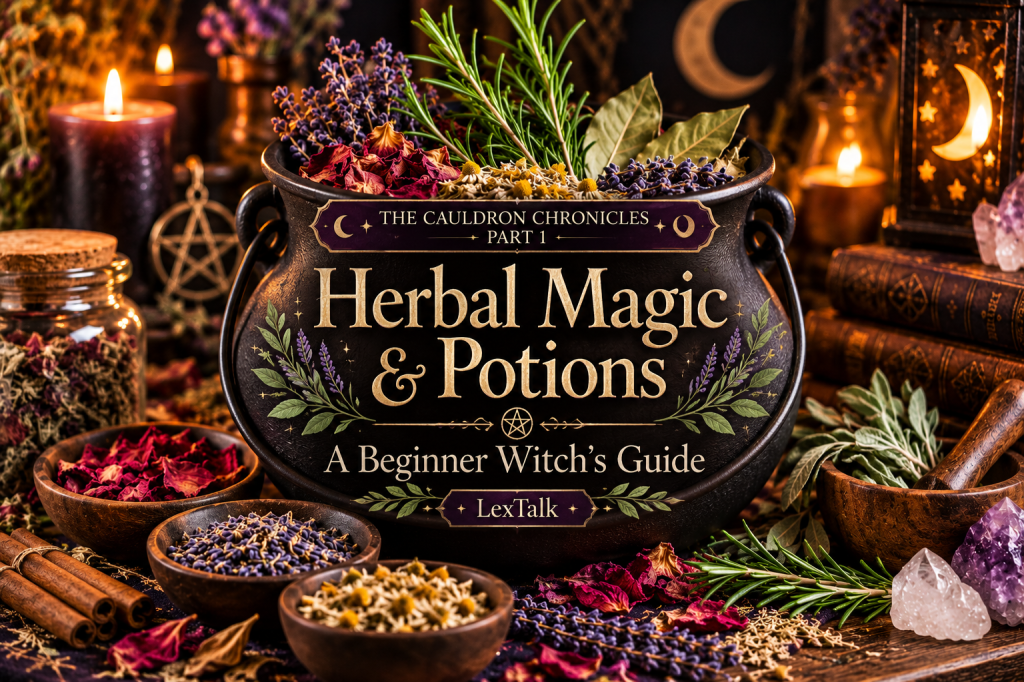
Herbal Magic & Potions — A Beginner Witch’s Guide to Working With Herbs
Welcome to the very first chapter of The Cauldron Chronicles, a LexTalk series exploring the history, symbolism, and practices of cauldron magic!
Today, we’re stepping into the fascinating world of herbal witchcraft, magical potions, and the centuries-old relationship between plants, folklore, and spirituality.
And yes, we’re going to figure out what we can actually put inside that beautiful cauldron!
I Bought a Witch’s Cauldron… Now What?! Exploring Herbal Magic & Potions
The Cauldron Chronicles | Part 1 of 10
There’s something about a cauldron that makes you feel just a little more magical.
Maybe it’s the image of a witch standing over a bubbling potion, carefully adding mysterious ingredients while whispering an ancient incantation.
Maybe it’s the history.
Or maybe it’s simply because cauldrons are absolutely beautiful.
Whatever the reason, I’ve wanted one for years.
And I finally got one!
During a recent trip to Marshall’s, I found a gorgeous, 4-quart, pre-seasoned cast-iron cauldron for around $40.
Naturally, I couldn’t leave without it.
I brought it home, admired it, and immediately started imagining all the wonderful things I could do with it.
Then something occurred to me.
I have absolutely no idea where to begin!
Okay, that’s not entirely true.
I’ve explored tarot, oracle cards, spiritual practices, and different aspects of witchcraft for quite some time.
But actually incorporating a cauldron into my craft?
That’s new territory.
And instead of rushing into something without understanding it, I’ve decided to research the different practices associated with cauldrons.
Which brings us to the very first installment of The Cauldron Chronicles.
Today, we’re exploring herbal magic and potions.
Grab your coffee, settle in, and prepare to learn a little witchcraft with me!
 What Is Herbal Magic?
Herbal magic is the practice of incorporating plants into spiritual rituals, symbolic workings, and intention-setting practices.
Different herbs are associated with different meanings.
Some represent protection.
Others symbolize love, prosperity, healing, remembrance, or purification.
In contemporary witchcraft, practitioners might combine herbs with written intentions, meditation, candles, crystals, or other ritual tools.
But here’s something I find particularly fascinating.
Herbal magic didn’t begin with the modern witchcraft movement.
Plants have been important to human cultures for thousands of years.
Long before modern medicine, people experimented with plants for food, fragrance, dyes, and remedies.
Plants also played important roles in religious ceremonies, funerary customs, offerings, and traditional healing practices.
Ancient Egyptian, Greek, Roman, and numerous other cultural traditions preserved knowledge and beliefs about plants.
However, not every historical herbal remedy was magical, and not every modern magical association can be traced directly to ancient practices.
The history is much more complicated—and interesting—than that.
Over the centuries, practical plant knowledge, religious symbolism, folklore, and magical traditions sometimes overlapped.
Today, many modern witches draw inspiration from those histories while developing their own personal practices.
And that’s what makes herbal magic such an interesting subject to explore.
 Why Are Cauldrons Associated With Herbal Witchcraft?
Before cauldrons became synonymous with witches, they were everyday household necessities.
Large cooking vessels were used to prepare meals, heat water, and boil ingredients.
But cauldrons also appeared in mythology and folklore.
In some Celtic stories, magical cauldrons are associated with abundance, transformation, and rebirth.
Later European folklore and artistic traditions helped popularize the image of witches gathering around bubbling cauldrons.
Eventually, the cauldron became one of the most recognizable symbols of witchcraft.
In modern spiritual practices, it can represent transformation.
Think about it.
You begin with individual ingredients.
Each ingredient has its own characteristics.
You combine them inside a vessel.
And together, they become something new.
The cauldron becomes a symbol of transformation, intention, and possibility.
I love that symbolism.
Especially because so much of life involves taking different experiences, emotions, and lessons and transforming them into something meaningful.
 Common Herbs and Their Magical Meanings
One of the first things I wanted to understand was which herbs are commonly used in witchcraft.
And let me tell you, there are a LOT!
Some of these plants are probably already sitting in your kitchen.
Rosemary — Protection & Remembrance
Rosemary has a long history of culinary, ceremonial, and symbolic use.
It is particularly associated with remembrance.
In contemporary witchcraft, rosemary is often used in rituals involving protection, clarity, and purification.
Magical associations: Protection, memory, cleansing, clarity.
Lavender — Peace & Tranquility
Lavender is widely recognized for its fragrance.
Its association with relaxation makes it a popular choice in modern spiritual practices centered on peace and rest.
Magical associations: Calm, harmony, tranquility, self-love.
Bay Leaves — Wishes & Manifestation
Bay laurel has a rich history in Mediterranean cultures.
Laurel wreaths were associated with victory and honor in ancient Greece and Rome.
Today, some modern witches use bay leaves in intention-setting and manifestation rituals.
Magical associations: Success, wishes, achievement, protection.
Cinnamon — Prosperity & Motivation
Cinnamon has been valued as a spice and traded across vast distances for centuries.
In modern magical correspondences, it’s frequently associated with abundance, warmth, energy, and success.
Magical associations: Prosperity, motivation, abundance, vitality.
Rose Petals — Love & Compassion
Roses have appeared in art, poetry, religion, and folklore throughout history.
In contemporary witchcraft, rose petals are frequently associated with romantic love, friendship, beauty, and self-compassion.
Magical associations: Love, emotional connection, compassion, beauty.
Mint — Growth & Abundance
Mint has a long history of culinary and aromatic use.
Some modern magical traditions associate it with prosperity, freshness, renewal, and positive change.
Magical associations: Abundance, renewal, clarity, growth.
Chamomile — Peace & Comfort
Chamomile has been used in traditional herbal preparations for centuries.
Modern magical practices often associate it with relaxation, peacefulness, and good fortune.
Magical associations: Peace, comfort, rest, good luck.
It’s important to remember that these correspondences are symbolic traditions, not scientifically established properties. Meanings can also differ between cultures and practitioners.
And just because an herb is considered magical—or even edible for humans—doesn’t mean it’s safe for every person or animal.
More on that shortly!
 What Exactly Is a Magical Potion?
When I hear the word potion, my imagination immediately goes somewhere between an old apothecary, a mysterious woodland cottage, and a Halloween movie.
But magical potions aren’t necessarily mysterious bubbling liquids.
In modern witchcraft, the word can describe several different kinds of preparations.
Some are symbolic mixtures that aren’t meant to be consumed.
Others are ordinary food-safe beverages prepared with a spiritual intention.
And some are botanical preparations intended for external use.
For beginners, I think it’s especially important to distinguish between these categories.
A ritual potion is not automatically safe to drink.
For example, combining dried herbs in a bowl while focusing on an intention is very different from brewing a tea.
An herb that has a symbolic association with protection or prosperity may not be appropriate for ingestion.
Some plants are poisonous.
Others can interact with medications.
And essential oils are highly concentrated substances that should never be casually added to drinks.
Personally, I’m most interested in beginning with symbolic herbal mixtures.
Something beautiful, meaningful, and simple.
And preferably something that won’t ruin my new cauldron!
Five Ways to Incorporate Herbs Into Cauldron Magic
Now we’re getting to the fun part!
Here are five beginner-friendly practices I’ve been researching.
1. Herbal Intention Bowls
An herbal intention bowl combines symbolic ingredients representing a specific goal.
For example, someone might create a mixture representing peace, gratitude, or personal growth.
The herbs don’t need to be burned, heated, or consumed.
They’re simply arranged as part of a ritual.
2. Protection Mixtures
Some modern witches combine plants symbolically associated with protection.
Rosemary is one popular example.
The mixture might be placed in a sachet or enclosed container as a reminder of personal boundaries and emotional well-being.
3. Prosperity Bowls
A prosperity bowl may contain symbolic objects representing abundance.
These could include coins, written goals, and carefully contained herbs.
I particularly like the idea of pairing this type of ritual with practical financial goals.
A little intention-setting combined with actual action!
4. Herbal Offerings
Some practitioners incorporate plants into devotional rituals or seasonal altar displays.
Offerings vary widely depending on the spiritual tradition.
Dried flowers, leaves, or other botanical objects might be used symbolically.
5. Seasonal Herbal Displays
This might be one of my favorite ideas.
Imagine creating a beautiful autumn arrangement inside a cauldron.
Dried flowers.
Colorful leaves.
Little seasonal decorations.
Perhaps a written intention tucked inside.
Then changing the arrangement as the seasons turn.
It’s simple, beautiful, and meaningful.
And honestly, it sounds like a wonderful way to begin.
 My First Beginner Cauldron Ritual: A Little Magic for New Beginnings
Since this is my first cauldron, I want my first herbal ritual to represent something meaningful.
And what better intention than welcoming new beginnings?
This is a ritual I’m considering trying as I begin exploring herbal magic.
Supplies Needed
– A clean, completely dry cauldron
– A small lidded glass jar or other secure container
– A small amount of dried culinary rosemary
– A piece of paper
– A pen
– Your favorite tarot or oracle deck, if desired
Step 1: Prepare Your Space
Find a quiet, comfortable location.
You don’t need candles, incense, or elaborate decorations.
Just somewhere you can relax and focus.
Place your cauldron on a sturdy surface.
Step 2: Choose Your Intention
Think about something you’d like to welcome into your life.
Maybe it’s confidence.
Maybe it’s creativity.
Perhaps it’s peace, patience, or the courage to explore something new.
Write your intention on a piece of paper.
For mine, I’m thinking:
I welcome curiosity, creativity, and the confidence to continue learning.
Step 3: Prepare Your Herbal Symbol
Place a small amount of dried rosemary inside the lidded jar.
For this ritual, rosemary will represent clarity and remembrance.
I love the idea of remembering why I started exploring my spiritual interests in the first place.
Step 4: Place Everything Inside the Cauldron
Place the sealed jar and folded intention inside your cauldron.
Take a moment to appreciate what each object represents.
There’s no need to burn or heat anything.
Step 5: Reflect
Close your eyes if you’re comfortable.
Take a few slow breaths.
Think about your intention.
What would welcoming more creativity actually look like?
What could you do tomorrow to move toward that goal?
Step 6: Optional Tarot or Oracle Card
If you enjoy divination, pull one card.
Ask:
What can I focus on as I begin this new chapter?
Reflect on the card’s symbolism and journal whatever comes to mind.
Step 7: Close Your Ritual
Thank yourself for making time to explore something meaningful.
Keep your intention somewhere safe, or record it in your journal.
That’s it!
No complicated spellwork.
No mysterious ingredients.
No fire.
Just a small ritual celebrating curiosity, reflection, and new beginnings.
And honestly, that sounds like the perfect first experience for my cauldron.
 Important Cauldron Safety: What Beginners Should Know
Now, this is something I want to take seriously.
Especially because I spent around $40 on my cauldron, absolutely love it, and have no desire to ruin it!
Mine is made from pre-seasoned cast iron.
That means it has a protective layer of oil-based seasoning bonded to the metal.
Although cast iron is incredibly durable, it still requires proper care.
Protecting the Cast Iron
Water left sitting inside cast iron can cause rust.
Acidic mixtures may affect the seasoning, particularly with prolonged contact.
After washing, cast iron should be thoroughly dried and cared for according to the manufacturer’s instructions.
For ritual mixtures, I’m planning to use removable containers inside my cauldron whenever possible.
This will help protect its finish.
What About Burning Herbs?
Here’s something important.
A cast-iron cooking vessel isn’t automatically an approved incense burner or indoor fire bowl.
Burning charcoal, incense, or herbs can create intense heat, smoke, and airborne particles.
A pre-seasoned surface can also be damaged by inappropriate heating.
Until I can verify the manufacturer’s instructions for my specific cauldron, I won’t be burning ritual materials directly inside it.
We’ll explore fire magic separately in the next installment.
Herbal Safety Around Cats
And of course, I have to think about Juggy!
Cats can be particularly sensitive to certain plants and concentrated essential oils.
Even familiar herbs aren’t automatically safe for pets.
Some can cause gastrointestinal irritation or more serious problems if ingested.
That’s why I’ll be keeping all loose herbs, botanical mixtures, and ritual supplies completely out of his reach.
I’ll also be avoiding essential oil diffusers and smoke-based rituals around him.
My witchcraft practice should never put my little furry companion at risk.
Never Assume a Magical Herb Is Medicinally Safe
One final reminder.
A plant’s historical or spiritual reputation doesn’t establish that it can safely treat a medical condition.
Some herbs can interact with prescription medications, cause allergic reactions, or be toxic in certain amounts.
For now, I’m treating my herbal magic as a symbolic and spiritual practice—not an experiment in homemade medicine.
Do You Have to Believe in Magic to Practice Herbal Rituals?
This is something I’ve been thinking about.
People approach witchcraft from many different perspectives.
Some believe rituals influence spiritual energies.
Others understand them as symbolic acts that help focus intentions.
Some incorporate them into religious devotion.
And others simply enjoy the history, folklore, creativity, and connection to nature.
Personally, I love exploring the mysterious side of life.
I enjoy asking questions.
I love learning about traditions and symbolism.
And I find something comforting about taking a few moments out of a busy day to focus on something meaningful.
Maybe that’s one of the things I appreciate most about rituals.
They encourage us to be intentional.
To slow down.
To reflect.
To appreciate the little things we sometimes overlook.
And if a beautiful cast-iron cauldron helps inspire that curiosity?
Well, I’m certainly not complaining!
 The Beginning of My Cauldron Chronicles
I started this journey with a simple question.
I bought a cauldron… now what?!
And already, I’m discovering that there’s so much more to these beautiful vessels than the stereotypical bubbling witch’s brew.
They carry centuries of history and folklore.
They appear in mythology.
They represent transformation.
And in modern witchcraft, they can become meaningful tools for personal spiritual practices.
I haven’t decided exactly how I’ll use mine long-term.
And I’m perfectly happy with that.
For now, I’m learning.
Exploring.
Asking questions.
And discovering which practices feel meaningful to me.
Next time, we’re going to explore something a little more intense.
Fire magic and burning rituals!
We’ll look at the history of fire symbolism, how burning rituals became associated with transformation and release, and what beginners need to understand before attempting anything involving flames.
Because as much as I love the idea of a magical cauldron filled with flickering fire, I also love my house, my cat, and my eyebrows.
Safety first, witches!
Let’s Talk!
Have you ever worked with herbs in your spiritual practice?
Do you have a favorite herb for intention-setting, protection, or seasonal rituals?
And if you own a cauldron, what was the very first thing you did with it?
I’d love to hear about your experiences!
Until next time, stay curious, embrace the mysterious, and never stop finding a little magic in the everyday.
With love and a little magic,
LexTalk


Leave a Reply