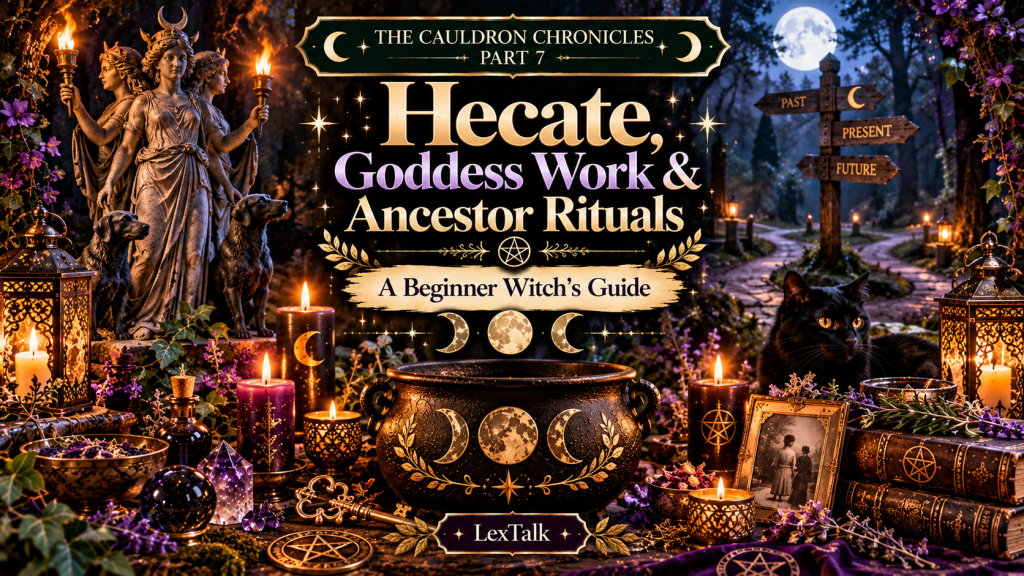
Hecate, Goddess Work & Ancestor Rituals — Exploring the Goddess of Crossroads, Magic & the Spirit World
Welcome back to The Cauldron Chronicles on LexTalk!
When I purchased my beautiful cast-iron cauldron, I knew I wanted to explore its many uses in witchcraft.
But I never imagined how much history, mythology, and spiritual symbolism I would discover along the way.
We’ve explored herbal magic, fire rituals, moon magic, protection, prosperity, and divination.
And today?
We’re exploring one of the most fascinating goddesses in Greek mythology.
Hecate. 

If you’ve been following my Daily Divine & Mysterious series, you already know that I’ve been exploring different deities and their fascinating histories.
But Hecate deserves a special place in this series.
After all, she’s frequently associated with witchcraft, magic, crossroads, the night, and the boundaries between the living and the dead.
And with Halloween approaching, I couldn’t imagine a more fitting topic!
But I have so many questions.
Who exactly was Hecate?
Why is she often depicted holding torches and keys?
What’s the significance of her three faces?
Did ancient Greeks actually worship her at crossroads?
And how can I respectfully incorporate her symbolism and ancestor remembrance into my modern cauldron practice?
Let’s explore!
Who Is Hecate? The Mysterious Greek Goddess of Crossroads
Hecate, also spelled Hekate, is a goddess from ancient Greek religion and mythology.
Today, she’s particularly popular among some contemporary witches and pagans.
But her history extends back thousands of years.
In Greek mythology, Hecate is commonly described as the daughter of the Titans Perses and Asteria.
One of her earliest surviving literary appearances occurs in Hesiod’s Theogony, generally dated to around the late eighth or seventh century BCE.
And here’s something that surprised me.
Hecate wasn’t originally portrayed exclusively as a dark goddess associated with ghosts and witchcraft.
In Hesiod’s account, she possessed considerable divine authority and could bestow blessings involving prosperity, victory, and success.
Her associations developed and changed throughout Greek and Roman antiquity.
Over time, she became increasingly connected with crossroads, thresholds, the night, magic, and the underworld.
According to [World History Encyclopedia’s history of Hecate](https://www.worldhistory.org/Hecate/?utm_source=chatgpt.com), her mythology encompasses both protective and potentially dangerous supernatural powers.
I find that fascinating.
Because when we see Hecate depicted in modern witchcraft artwork, she’s frequently surrounded by skulls, dark forests, black dogs, and mysterious symbols.
But there’s so much more to her history.
She wasn’t simply a goddess of darkness.
She was also associated with protection, guidance, and transitions.
And that brings us to one of my favorite stories.
 Hecate and Persephone: The Goddess Who Carried the Torch
One of Hecate’s most recognizable appearances in Greek mythology comes from the Homeric Hymn to Demeter.
The story involves Persephone, the daughter of Demeter, who is taken into the underworld by Hades.
Demeter becomes devastated by her daughter’s disappearance.
She searches desperately for Persephone.
And Hecate plays an important role.
According to the ancient hymn, Hecate hears Persephone’s cries but doesn’t witness what happened.
When she encounters Demeter, she carries a torch.
The two goddesses then seek information from Helios, the sun god, who witnessed the abduction.
Later in the story, after Persephone returns, Hecate becomes her companion.
You can explore the ancient passages collected in [Theoi’s Hecate mythology archive](https://www.theoi.com/Khthonios/Hekate.html?utm_source=chatgpt.com).
What I find particularly beautiful about this story is the symbolism.
Imagine someone searching desperately for answers.
They’re frightened.
They’re grieving.
They don’t know what happened.
And then someone appears carrying a light.
Hecate doesn’t magically solve everything.
But she helps guide the search.
Sometimes guidance doesn’t mean having every answer. Sometimes it means having enough light to take the next step.
I absolutely love that interpretation.
It’s one of the reasons the torch has become such a meaningful symbol in modern representations of Hecate.
Why Is Hecate Associated With Keys?
If you’ve seen contemporary Hecate altars, you’ve probably noticed that keys are incredibly popular.
Antique skeleton keys.
Silver keys.
Gold keys.
Keys hanging from necklaces.
But why?
In ancient religious imagery and later traditions, Hecate became associated with entrances, gates, and boundaries.
She was sometimes identified with the epithet Kleidouchos, meaning key-holder.
Keys naturally symbolize the ability to open or close something.
They represent access.
Protection.
Opportunity.
And transition.
I think that’s why they’re such powerful symbols in contemporary goddess work.
Imagine standing in front of a locked door.
You don’t know what’s behind it.
You might feel excited.
Or frightened.
Or completely uncertain.
But the key represents possibility.
In modern spiritual interpretation, a key might symbolize opening yourself to a new opportunity or deciding that a particular chapter of your life needs to close.
I love that symbolism.
Especially because life is filled with transitions.
Sometimes we’re starting something new.
Sometimes we’re leaving something behind.
And sometimes we’re standing somewhere in between.
Which leads us to Hecate’s most recognizable association.
Crossroads.
 Hecate and the Meaning of Crossroads
Throughout ancient Greek religion, Hecate was associated with roads, entrances, and places where pathways intersected.
She was particularly connected with three-way crossroads.
Small representations of Hecate, sometimes called hekataia, could be placed near entrances and intersections.
These images were associated with protection and the goddess’s presence at boundaries.
Now, think about what a crossroads represents.
You’re traveling along a path.
Eventually, you reach a place where several directions are possible.
You have to choose.
Do you continue forward?
Turn left?
Turn right?
Or reconsider where you’re going entirely?
That’s such a relatable metaphor for life.
In contemporary spiritual practices, crossroads are often interpreted as symbols of decision-making and transformation.
And I can understand why.
There are so many moments when we don’t know which direction to take.
Career decisions.
Relationships.
Personal goals.
Financial choices.
Even small everyday decisions can feel overwhelming.
I think the symbolism of Hecate at the crossroads encourages an interesting question.
What if we stopped searching for the perfect path and started considering which direction best reflects our values?
Not because a goddess is guaranteed to choose for us.
But because reflection can help us make more intentional decisions.
Why Does Hecate Have Three Faces?
One of the most recognizable representations of Hecate depicts her with three bodies or three faces.
And I wanted to understand why.
Ancient Greek and Roman artwork sometimes portrayed Hecate in a triple form, with figures facing different directions.
This imagery is particularly appropriate for a goddess associated with crossroads.
A three-sided figure can symbolically observe multiple directions.
The [Metropolitan Museum of Art](https://www.metmuseum.org/art/collection/search/255881?utm_source=chatgpt.com) preserves a marble statuette of triple-bodied Hecate and the Three Graces dating to the first or second century CE.
I would love to see an artifact like that in person!
There’s something incredible about realizing that people were creating these representations nearly two thousand years ago.
Does Hecate Represent the Maiden, Mother, and Crone?
Here’s an important distinction.
In some contemporary witchcraft traditions, triple goddesses are interpreted through the Maiden, Mother, and Crone framework.
This framework is frequently associated with life stages and the waxing, full, and waning moon.
However, we shouldn’t assume that every ancient threefold depiction of Hecate originally represented those three roles.
The modern Maiden-Mother-Crone interpretation isn’t a historically established universal explanation for Hecate’s ancient triple imagery.
Her threefold form was strongly associated with crossroads and directional guardianship.
I think understanding that difference is important.
We can appreciate contemporary symbolism while still respecting the historical context.
And honestly, the ancient imagery is fascinating enough without needing to add meanings that may not have existed originally.
 Why Are Dogs Associated With Hecate?
This might be one of the most interesting details I’ve discovered.
Dogs appear frequently in Hecate’s mythology and religious associations.
In some ancient accounts, the sound of barking or howling dogs signaled her approach.
Dogs were also associated with guarding entrances and boundaries.
And that symbolism makes sense.
Dogs have protected homes and accompanied humans for thousands of years.
They’re alert.
Protective.
And often sensitive to unfamiliar sounds and movement.
In ancient Hecate traditions, however, the relationship with dogs also included sacrificial practices that modern readers may find disturbing.
It’s important to acknowledge those historical realities rather than presenting every ancient ritual as something appropriate to recreate.
Modern goddess work doesn’t require harming animals.
For my own practice, I would never incorporate animal sacrifice or anything that could hurt a living creature.
A drawing of a dog, a small decorative figure, or simply learning about the symbolism is more than enough.
And speaking of animals…
I have a very curious cat who would probably like to investigate my altar!
But we’ll get to Juggy’s safety shortly.
 What Is Goddess Work in Modern Witchcraft?
Now that we’ve explored some of Hecate’s history, I want to understand how people incorporate deities into contemporary spiritual practices.
Goddess work can mean different things depending on someone’s religious beliefs and traditions.
Some practitioners worship goddesses as divine beings.
Others develop devotional relationships through prayer, offerings, meditation, or ritual.
Some approach goddesses primarily through mythology and symbolism.
And others explore them as cultural or psychological archetypes.
These approaches aren’t interchangeable, and not every practitioner understands deity work in the same way.
I think that’s important to recognize.
Because I don’t want to assume that everyone interested in Hecate practices witchcraft in exactly the same manner.
Personally, I’m fascinated by the historical and symbolic aspects.
I enjoy learning about ancient religions.
I love exploring mythology.
And I appreciate how certain symbols can encourage meaningful personal reflection.
For someone beginning to explore Hecate, studying her history is a wonderful place to start.
You don’t need an expensive altar.
You don’t need a particular crystal.
And you certainly don’t need to purchase elaborate ritual supplies.
Curiosity, research, and respect are enough to begin learning.
 What Is Hecate’s Deipnon?
Here’s a tradition I was especially excited to research.
Hecate’s Deipnon!
The word deipnon refers to a meal or supper.
In ancient Greek religious practices, food offerings associated with Hecate were sometimes placed at crossroads toward the end of the lunar month.
These offerings could be connected with purification, protection, and the transition into a new month.
Ancient literary references describe food being left at crossroads, where it might also be consumed by people experiencing poverty.
The precise details varied, and our surviving evidence doesn’t provide one universal ritual performed identically by every ancient household.
In contemporary Hellenic paganism, some practitioners observe Hecate’s Deipnon around the dark moon or the end of the lunar month.
Modern practices may involve cleaning the home, making offerings, reflecting on the previous month, or preparing for a fresh beginning.
But here’s something important.
A modern Deipnon ritual isn’t automatically an exact reconstruction of an ancient Greek ceremony.
Practitioners may adapt historical traditions to their circumstances.
And for me, that distinction matters.
I want to understand the original historical context while recognizing that modern spiritual practices continue to evolve.
Do Offerings Need to Be Left at a Crossroads?
Not necessarily.
Some modern practitioners choose to leave offerings outdoors.
But that can create practical concerns.
Food may attract wildlife.
Certain ingredients can be harmful to animals.
And leaving objects or food on public property may create litter or violate local rules.
For my household, I would rather make a symbolic offering indoors or perform a charitable act.
For example, donating food to a local food bank could be a meaningful contemporary gesture inspired by themes of nourishment and generosity.
It wouldn’t be identical to an ancient Deipnon.
But it could reflect values that matter to me.
And I like that idea.
 Hecate and the Spirit World
Hecate’s associations with the underworld, ghosts, and transitions between realms became increasingly prominent in ancient literature.
This is one reason she’s frequently included in contemporary discussions of ancestor work.
However, I want to clarify something.
Hecate worship and ancestor veneration are not the same practice.
Ancient Greek religion included various customs for honoring deceased family members and the dead.
Hecate had her own religious roles and associations.
Although these subjects can overlap symbolically, we shouldn’t assume that every ancestor ritual involving Hecate today was practiced in the same way in ancient Greece.
Modern witches sometimes combine deity devotion with ancestor remembrance.
Others keep these practices completely separate.
Both approaches can be meaningful within their respective belief systems.
And that brings me to a subject that feels especially personal.
Remembering the people we’ve lost.
 What Is Ancestor Work?
Ancestor work is a broad term used in contemporary spirituality for practices intended to honor, remember, or connect with deceased family members and those who came before us.
Different cultures have developed their own traditions for remembering the dead.
Some involve religious ceremonies.
Others include maintaining graves, preparing special foods, displaying photographs, or gathering to share memories.
In certain spiritual traditions, people believe ancestors can provide guidance or protection.
Other people approach ancestor remembrance without supernatural beliefs.
They simply want to preserve family stories and maintain a sense of connection.
And I think that’s beautiful.
Because remembering someone doesn’t require us to agree on exactly what happens after death.
We can honor the influence someone had on our lives.
We can remember their favorite songs.
Their traditions.
Their sense of humor.
The things they taught us.
And the memories that still make us smile.
For me, this subject naturally makes me think about my mom.
There are little things that remind me of her all the time.
Certain scents.
Books.
Television shows.
Ordinary memories that suddenly feel incredibly meaningful.
And I think that’s one reason ancestor remembrance interests me.
It’s not necessarily about trying to communicate with someone who has passed away.
Sometimes it’s simply about making space to remember them.
Love doesn’t disappear just because someone is no longer physically present in our lives.
And I think creating a small remembrance ritual could be a beautiful way to honor that.
Why Use a Cauldron for Goddess Work and Ancestor Rituals?
Now we’re getting back to my beautiful cast-iron cauldron!
Historically, cauldrons were practical vessels used for preparing food, heating liquids, and other household activities.
They also appear in folklore and mythology.
In contemporary witchcraft, cauldrons are often used symbolically to represent transformation, containment, nourishment, and renewal.
But I want to be careful about making historical claims.
There’s no established evidence that the specific modern practice of placing ancestor photographs and symbolic keys inside a cast-iron witch’s cauldron was a standard ancient Greek Hecate ritual.
That’s a contemporary adaptation.
And that’s perfectly fine, as long as we’re clear about what we’re doing.
For my practice, I like the idea of using the cauldron as a symbolic container.
A place to hold written intentions.
A place to honor memories.
And a reminder of the things that connect our past with our present.
I especially love the idea of combining Hecate’s symbolism of guidance and crossroads with an ancestor remembrance practice.
Not because I’m attempting to recreate an ancient ceremony.
But because those themes feel meaningful to me.
 Beginner Ritual: The Cauldron of Remembrance & Guidance
For today’s ritual, I want to create something peaceful, personal, and beginner-friendly.
I want to honor the memory of someone I love while reflecting on the guidance and lessons they’ve left behind.
And I want to incorporate Hecate’s symbolism of light, thresholds, and crossroads.
This will be a modern symbolic ritual inspired by those themes, rather than a historically reconstructed Greek ceremony.
 Supplies Needed
– My clean, completely dry cast-iron cauldron
– A battery-operated candle
– A small piece of paper
– A pen
– A photograph or written name of someone I want to remember
– A paper drawing of a key
– A soft cloth to protect the cauldron
– My journal
– Optional: a meaningful family keepsake
No flames.
No incense.
No essential oils.
No complicated ingredients.
And nothing that could damage the seasoning on my cauldron.
Step 1: Prepare My Altar
I’ll begin by tidying my altar and creating a peaceful atmosphere.
I’ll place my cauldron in the center of my workspace.
Then I’ll turn on my battery-operated candle.
The light will represent guidance.
I’ll take a few slow breaths and allow myself to settle into the moment.
I don’t need to feel anything extraordinary.
I simply want to be present.
Step 2: Reflect on Hecate’s Symbolism
Next, I’ll place my paper key beside the cauldron.
I’ll think about Hecate’s historical associations with thresholds and crossroads.
Then I’ll ask myself:
Am I currently facing an important decision?
Is there something I’m ready to leave behind?
What would help me move forward with greater confidence?
I love the idea of using the key as a reminder that choices can create new opportunities.
And sometimes moving forward requires us to close one chapter before opening another.
Step 3: Honor Someone I Love
Now I’ll choose someone I want to remember.
For me, that might be my mom.
I’ll place her photograph or written name beside the cauldron.
Then I’ll spend a few moments thinking about a happy memory.
Something that makes me smile.
Maybe a tradition we shared.
A conversation.
A favorite book.
Or something she taught me.
I’ll write down one memory or lesson I want to preserve.
I think this part could be especially meaningful.
Because sometimes the smallest memories are the ones we treasure most.
Step 4: Place My Written Reflection Inside the Cauldron
I’ll fold the paper and place it inside the dry cauldron.
If I’m using a keepsake, I’ll keep it beside the vessel rather than risk scratching the interior.
The cauldron will represent holding memories with care.
The key will represent the future.
And the candle will symbolize remembrance and guidance.
I love how simple objects can carry such personal meaning.
Step 5: Speak My Intention
I’ll take a moment to say:
I honor the memories that shaped me.
I remember those whose love remains part of my story.
May the lessons of the past help guide my future.
May I approach life’s crossroads with wisdom and courage.
As I move forward, I carry gratitude for what came before.
And I welcome the opportunity to continue growing.
These words are a personal reflection.
They aren’t intended to summon spirits or guarantee supernatural communication.
They’re simply a way to acknowledge the people and experiences that have shaped my life.
Step 6: Journal My Experience
Afterward, I’ll open my journal.
I’ll write about the person I remembered.
What memory came to mind?
What did that person teach me?
Is there a tradition I’d like to continue?
And is there something from their life that inspires how I want to live mine?
I also want to consider how these memories connect with my current goals.
Sometimes we carry lessons from people we love without even realizing it.
I think journaling could help me recognize those connections.
Step 7: Close the Ritual
I’ll take one final moment to appreciate the experience.
Then I’ll remove the paper from the cauldron.
I’ll store the photograph or keepsake somewhere safe.
And I’ll turn off my battery-operated candle.
That’s it.
A simple remembrance ritual inspired by Hecate’s symbolism of guidance and transitions.
No expensive supplies.
No dangerous ingredients.
And no pressure to experience anything supernatural.
Just a quiet moment of reflection.
Five Ways to Honor Hecate’s Symbolism in Everyday Life
One thing I’m discovering throughout The Cauldron Chronicles is that spiritual symbolism doesn’t have to remain confined to an altar.
It can also inspire ordinary actions.
Here are five ways I might explore Hecate’s themes in daily life.
1. Study ancient mythology. Learning about Hecate’s historical roles can deepen my understanding of the goddess beyond modern social media interpretations.
2. Reflect before making decisions. When I reach a personal crossroads, I can take time to consider my options rather than rushing into a decision.
3. Keep a symbolic key. A decorative key can serve as a reminder of personal boundaries, opportunities, and transitions.
4. Honor family memories. Preserving photographs, recipes, stories, and traditions can help maintain meaningful connections with loved ones.
5. Practice generosity. Supporting a food bank or helping someone in need can be a thoughtful contemporary way to express values of care and community.
I especially love the last two.
Because spirituality doesn’t always have to involve elaborate ceremonies.
Sometimes meaningful actions are the most powerful expressions of our values.
 Hecate Rituals and Cat Safety: Keeping Juggy Protected
Of course, we need to talk about Juggy!
Because if there’s one thing I’ve learned about cats, it’s that they love investigating anything new.
And a cauldron surrounded by keys, candles, photographs, and decorations?
That sounds like something he’d be very interested in!
But I want my spiritual practice to remain safe for him.
So I’m keeping a few precautions in mind.
I won’t leave small keys, charms, or crystals where he could swallow them.
I’ll avoid loose strings, ribbons, and decorative cords.
I won’t use essential oils or incense around him.
And I’ll make sure my cauldron is placed on a sturdy surface where he can’t knock it over.
According to the [ASPCA’s guidance on essential oils and pets](https://www.aspca.org/news/essentials-essential-oils-around-pets?utm_source=chatgpt.com), concentrated essential oils can pose serious health risks to cats and other animals.
Some modern witchcraft rituals recommend burning herbs or diffusing essential oils.
But those ingredients aren’t necessary for the practice I’m creating.
If Juggy ever ingests a questionable ritual ingredient or shows signs of poisoning, I’ll contact a veterinarian or animal poison control service immediately.
I love my magical decorations.
But I love my cat more!
A pet-friendly altar is always going to be my priority.
Fire Safety: Do Hecate Rituals Require Real Torches or Candles?
Hecate’s association with torches is one of her most recognizable features.
And many modern altars dedicated to her include candles.
But here’s something important.
You don’t need an actual flame to explore the symbolism of light.
A battery-operated candle can represent guidance just as effectively within a personal symbolic ritual.
And that’s what I’ll be using.
According to the [U.S. Fire Administration’s candle safety recommendations](https://www.usfa.fema.gov/prevention/home-fires/prevent-fires/candle/?utm_source=chatgpt.com), lit candles should be kept at least 12 inches away from anything that can burn.
They should also be placed in stable holders and extinguished whenever leaving a room.
With pets, paper intentions, altar cloths, and books nearby, real flames can introduce unnecessary risks.
I also won’t burn photographs, written intentions, herbs, or offerings inside my cauldron.
A cast-iron vessel may be heat-resistant, but that doesn’t automatically make every decorative cauldron suitable for burning materials.
And even after a flame is extinguished, hot cast iron can remain dangerous.
For me, a flameless candle is the easiest and safest option.
The symbolism is what matters.
Not the size of the flame.
Cast-Iron Cauldron Care: Protecting the Seasoning
Because my cauldron is one of my favorite additions to my altar, I want to make sure I’m taking proper care of it.
Cast-iron seasoning is a protective layer formed when oil bonds to the metal through heat.
This layer helps protect the iron from rust.
But it doesn’t make the surface indestructible.
According to [Lodge Cast Iron’s official cleaning instructions](https://www.lodgecastiron.com/pages/how-to-clean?utm_source=chatgpt.com), cookware-grade seasoned cast iron should be cleaned, dried completely, and maintained with a thin layer of oil when appropriate.
For today’s ritual, I’ll follow several precautions.
Keep the cauldron dry. I won’t leave water, liquid offerings, or damp ingredients inside it.
Protect the interior. I’ll use a soft cloth beneath any decorative objects that could scratch the surface.
Avoid salt mixtures. Salt combined with moisture can contribute to corrosion.
Remove offerings afterward. Paper intentions, photographs, and keepsakes shouldn’t be left inside the cauldron indefinitely if they could trap moisture or damage the finish.
Avoid direct flames. Unless the manufacturer specifically confirms that the cauldron is designed for heating, I won’t expose it to fire or high temperatures.
Follow manufacturer instructions. Decorative cauldrons may have coatings or finishes that make them unsuitable for cooking or oven seasoning.
If my cauldron ever develops rust, I’ll address it according to its manufacturer’s recommendations.
And I won’t assume that a decorative cauldron is food-safe simply because it’s made from cast iron.
Taking care of my tools is part of maintaining my practice.
And I want this beautiful cauldron to last for years.
Do You Have to Worship Hecate to Work With Her Symbolism?
This is something I think beginners should understand.
There isn’t one universal approach to deity work.
Some people worship Hecate as a divine being.
Others honor her through contemporary pagan devotional practices.
Some study her mythology from a historical perspective.
And others incorporate her symbolism into personal reflection.
These approaches involve different beliefs and levels of religious commitment.
I wouldn’t want to tell someone that they must believe in a particular supernatural experience to appreciate ancient mythology.
But I also wouldn’t want to dismiss the religious significance Hecate holds for people who sincerely worship her.
For me, respect is important.
That means learning about the historical traditions.
Acknowledging the difference between ancient practices and modern adaptations.
And avoiding claims that I can guarantee spiritual results.
I think there’s room for curiosity, reverence, and thoughtful exploration.
And that’s exactly what I want The Cauldron Chronicles to encourage.
Can Ancestor Rituals Help Us Process Grief?
This is a question I found especially meaningful while researching today’s topic.
When we lose someone, our relationship with their memory often continues.
We might remember their advice.
Repeat their favorite sayings.
Cook recipes they loved.
Or find ourselves smiling when something reminds us of them.
For some people, remembrance rituals provide a comforting way to acknowledge those connections.
Writing a letter to someone who has died, looking through photographs, or sharing family stories can be meaningful activities.
However, rituals aren’t a substitute for mental health care when someone is experiencing overwhelming or persistent grief.
And they won’t necessarily feel comforting to everyone.
Sometimes remembering someone brings happiness.
Other times, it brings sadness.
And sometimes it brings both.
I think that’s part of what makes grief so complicated.
For my own practice, I like the idea of creating a small space for remembrance without feeling pressured to experience a particular emotion.
I don’t need to receive a sign.
I don’t need to hear a message.
And I don’t need to believe that something supernatural has happened.
Sometimes remembering someone is enough.
The people we love can continue influencing our lives through the memories, lessons, and traditions they leave behind.
And I think that’s something worth honoring.
My Biggest Lesson From Hecate, Goddess Work & Ancestor Rituals
When I started researching this topic, I expected to learn about mysterious goddesses, ancient offerings, keys, and crossroads.
And I certainly did!
But what surprised me most was how much of the symbolism connected with ordinary life.
Hecate’s torches made me think about guidance.
Her keys made me think about opportunities.
Her crossroads made me think about decisions.
And her associations with boundaries between worlds encouraged me to reflect on memory, loss, and the people who have shaped my life.
I think that’s what I’m enjoying most about this series.
Every topic introduces me to something new.
But it also encourages me to think about familiar experiences from a different perspective.
I’m not trying to become an expert overnight.
I’m learning.
Researching.
Asking questions.
And discovering which traditions and symbols resonate with me.
And I love that!
Because the more I learn about witchcraft and its many historical influences, the more I realize just how much there is left to explore.
Sometimes the most meaningful magic isn’t about changing the world around us. It’s about changing how we understand our place within it.
The Cauldron Chronicles: Our Journey So Far
I can’t believe we’re already seven installments into this series!
When I first purchased my cast-iron cauldron, I was so excited that I almost didn’t want to use it.
Now I’m discovering just how many different practices and traditions can be explored through its symbolism.
So far, we’ve covered:
1. Herbal Magic & Potions
2. Fire Magic & Burning Rituals
3. Moon Magic & Water Rituals
4. Protection, Banishing & Cleansing
5. Prosperity, Abundance & Manifestation
6. Divination, Tarot & Scrying
7. Hecate, Goddess Work & Ancestor Rituals
And we still have three more fascinating topics to explore!
 Coming Next: Samhain & Seasonal Celebrations
Our next installment is going to be especially exciting!
The Cauldron Chronicles: Part 8 — Samhain & Seasonal Celebrations.
And with Halloween right around the corner, I couldn’t imagine a more perfect time to explore it!
We’ll investigate the historical origins of Samhain, its connections with seasonal transitions and Irish traditions, and how modern witches incorporate cauldrons into autumn celebrations.
We’ll also explore the relationship between Samhain and Halloween, including which popular claims about their history are supported by evidence.
And, of course, we’ll create a beginner-friendly seasonal ritual that’s safe for my cast-iron cauldron and my curious little Juggy.
I cannot wait!
Let’s Talk!
Have you ever explored the mythology of Hecate?
Do you incorporate goddess work into your spiritual practice?
Have you ever created an altar or remembrance ritual for someone you love?
And here’s something I’m especially curious about.
If you could ask for guidance at one crossroads in your life right now, what would it be?
For me, I think it would involve figuring out how to continue growing my creative projects while balancing everything else life throws my way.
Because sometimes I have so many ideas that choosing which direction to take can be a challenge!
Until next time, stay curious, embrace the mysterious, and remember to find a little magic in the everyday.
With love and a little magic,
LexTalk


Leave a Reply