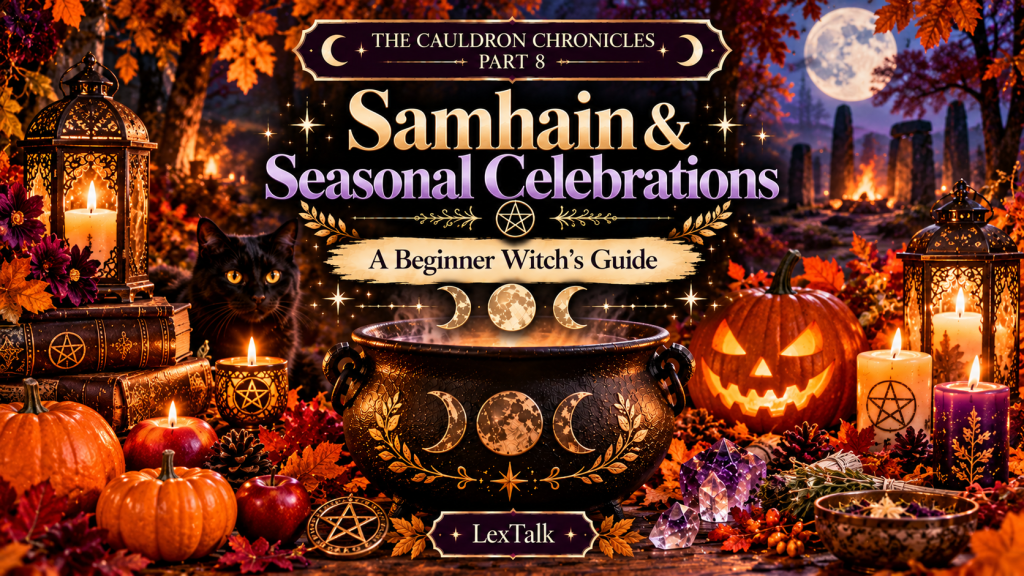
Samhain & Seasonal Celebrations — The Ancient Traditions Behind Halloween and the Magic of the Changing Seasons
Welcome back to The Cauldron Chronicles on LexTalk!
Okay, I have been looking forward to this installment!
If you’ve been following LexTalk, you probably already know that I absolutely LOVE Halloween.
The decorations. The spooky movies. The pumpkins. The candles. The mysterious atmosphere that seems to settle over everything as October comes to an end.
There’s something about this time of year that makes me ridiculously happy.
I love opening the windows when the weather cools down, lighting my favorite fall-scented candles, and curling up under a blanket with a good Halloween movie.
And now that I have my beautiful cast-iron cauldron?
Well, you KNOW I want to incorporate it into my favorite season!
But as I’ve been exploring witchcraft and its fascinating history, I’ve realized that Halloween has a much deeper and more complicated story than I originally understood.
Which brings us to today’s topic.
Samhain! 
What exactly is Samhain?
Was it really the original Halloween?
Why do people associate this time of year with spirits and the dead?
What’s the significance of bonfires, carved vegetables, and seasonal celebrations?
And how can I incorporate my cauldron into a meaningful Samhain-inspired ritual without accidentally setting something on fire?
Because let’s be serious.
I love my cauldron.
But I also love my townhouse.
And Juggy probably wouldn’t appreciate an indoor bonfire!
Let’s explore the fascinating history of Samhain, its relationship with Halloween, and how modern witches celebrate the changing seasons.
What Is Samhain?
First things first.
Samhain is commonly pronounced SAH-win, although pronunciation varies across Gaelic languages and dialects.
It is a traditional Gaelic seasonal festival associated with the end of the harvest period and the beginning of winter.
Historically, Samhain was particularly important in Ireland, although related seasonal traditions also developed in other Gaelic-speaking communities.
The festival is associated with November 1, with celebrations traditionally beginning the evening before.
That means October 31!
Sound familiar?
According to the [National Museum of Ireland’s Folklife Collection](https://source.museum.ie/en-IE/Collections-Research/Folklife-Collections/Folklife-Collections-List-%281%29/Religion-and-Calendar-Customs/Hallowe-en-Samhain?utm_source=chatgpt.com), Samhain marked the first day of winter, while the preceding evening was traditionally celebrated with food, games, and gatherings.
And here’s something I found interesting.
Samhain wasn’t originally just about ghosts, witches, and spooky decorations.
It was connected to something incredibly important for agricultural communities.
The changing seasons and the need to prepare for winter.
Imagine living hundreds of years ago.
You don’t have grocery stores where you can purchase fresh produce throughout the year.
You don’t have central heating.
You can’t simply turn on a light when the sun disappears.
Your survival depends heavily on the weather, your harvest, your animals, and the supplies you’ve managed to preserve.
The arrival of winter would have been a significant event.
And that helps explain why seasonal transitions became so meaningful.
 The Historical Origins of Samhain
Samhain is one of the traditional Gaelic seasonal festivals.
The others include Imbolc, Bealtaine, and Lughnasadh.
Together, these festivals marked important transitions throughout the agricultural year.
Samhain was associated with the arrival of the darker, colder portion of the year.
In medieval Irish literature, it also appears as an important setting for gatherings, supernatural encounters, and extraordinary events.
But here’s where we need to separate history from popular internet claims.
You might have read that Samhain was celebrated in exactly the same way for thousands of years.
Or that every ancient Celtic community practiced identical rituals.
Or that we know precisely what people did during prehistoric Samhain ceremonies.
Unfortunately, the surviving historical evidence doesn’t support that level of certainty.
Much of what we know comes from medieval Irish literature and later folklore.
Those sources are valuable, but they were recorded long after some of the traditions they describe may have begun.
The [British Museum’s exploration of Samhain and ancient cauldrons](https://www.britishmuseum.org/blog/frightening-fiestas-and-sacred-ceremonies?utm_source=chatgpt.com) discusses the festival’s seasonal importance while acknowledging the uncertainty surrounding much older prehistoric celebrations.
And I actually appreciate that distinction.
I want to learn about ancient traditions.
But I don’t want to repeat something as historical fact simply because it sounds magical.
Sometimes the real history is mysterious enough!
 Is Samhain the Original Halloween?
Now we’re getting to one of my favorite questions.
Is Halloween actually an ancient pagan holiday?
Well…
Modern Halloween developed through several overlapping traditions.
And Samhain is an important part of that history.
But the relationship isn’t quite as simple as saying Halloween is exactly the same holiday ancient people celebrated.
Traditional Irish and Scottish seasonal customs contributed to Halloween.
Christian observances also played a role.
All Saints’ Day is observed on November 1 in many Western Christian traditions.
The evening before became known as All Hallows’ Eve.
Over time, that name developed into Halloween.
All Souls’ Day, observed on November 2 in Western Christianity, added another occasion associated with remembering the dead.
Regional folklore, seasonal games, disguises, and later American customs also influenced the holiday.
The result?
The Halloween we recognize today!
A fascinating combination of religious observances, folklore, seasonal celebrations, and popular culture.
And I think that’s incredible.
Because when I’m decorating my home with pumpkins and spooky decorations, I’m participating in a holiday shaped by centuries of cultural change.
Even if my particular decorations came from a modern Halloween store!
 Why Is Samhain Associated With Spirits and the Dead?
This is where things become especially mysterious.
In Irish folklore and medieval storytelling, Samhain was associated with unusual encounters involving supernatural beings and the Otherworld.
The Otherworld appears throughout Irish mythology as a realm associated with supernatural beings, extraordinary places, and experiences beyond ordinary human life.
In later Halloween folklore, people also believed that spirits of the dead might return to their former homes.
The National Museum of Ireland documents traditions involving the expectation that deceased family members might return during Halloween, alongside beliefs about potentially dangerous supernatural beings.
But what about the famous saying that the veil between worlds becomes thinner?
You’ve probably heard that before.
I certainly have!
It’s an incredibly popular expression in modern witchcraft.
 Is the Veil Really Thinner During Samhain?
In contemporary pagan and witchcraft traditions, Samhain is often described as a time when the boundary between the living and the dead becomes thinner.
This is a spiritual belief and symbolic interpretation.
It isn’t something that has been scientifically demonstrated.
And the specific modern phrase about a thinning veil shouldn’t automatically be treated as a direct quotation from ancient Celtic religion.
Historical Irish stories did associate Samhain with encounters between ordinary and supernatural realms.
But modern interpretations have developed considerably over time.
Personally, I find the symbolism fascinating.
Especially because this time of year naturally encourages reflection.
The days grow shorter.
The weather changes.
Plants begin entering dormancy.
And we’re reminded that everything in nature moves through cycles.
Growth.
Change.
Decline.
And renewal.
I can understand why people connect those transitions with thoughts about life, death, and remembrance.
 The History of Samhain Bonfires
When researching Samhain, one tradition appears repeatedly.
Bonfires!
Fire has been associated with seasonal celebrations in many cultures.
It can provide warmth.
Light.
Protection.
And a gathering place for communities.
Bonfires also feature in Irish Halloween traditions, although specific customs have varied across regions and historical periods.
According to the [National Museum of Ireland’s discussion of Halloween customs](https://source.museum.ie/en-IE/News/2023/Ghost-turnips%2C-pucas%2C-fortune-telling-and-evil-abd?utm_source=chatgpt.com), bonfires have been associated with community gatherings, protection, and the transition into the darker season.
And that symbolism makes sense to me.
Imagine standing outside on a cold autumn evening.
The sky is dark.
The air is chilly.
And a large fire illuminates the people gathered around it.
There’s something almost mesmerizing about watching flames.
But here’s an important distinction.
Not every modern Samhain fire ritual is a documented reconstruction of an ancient ceremony.
Some contemporary witches use candles, bonfires, or burning rituals to symbolize releasing the past.
Others use fire as a symbol of protection or renewal.
Those practices can be meaningful without claiming that every detail comes directly from ancient Ireland.
For my own cauldron practice?
I’m sticking with symbolic fire.
Because a battery-operated candle can represent light without creating a fire hazard.
And I think that’s a perfectly reasonable trade-off!
Wait… Jack-o’-Lanterns Weren’t Originally Pumpkins?!
Okay.
This might be one of my favorite discoveries from today’s research.
You know those beautifully carved pumpkins we put outside our homes?
Well, in traditional Irish Halloween customs, people sometimes carved turnips instead!
TURNIPS!
Can you imagine trying to carve an elaborate Halloween face into a turnip?
Pumpkins are difficult enough!
In Ireland, carved turnips were used to create frightening lanterns.
The National Museum of Ireland preserves a model based on a traditional ghost turnip from County Donegal, documenting a style used around 1900.
These lanterns were associated with frightening people and with folklore surrounding wandering spirits.
Pumpkins later became the familiar American version of the tradition.
I absolutely love this piece of history.
Because it connects something we still do today with older seasonal customs.
And now I’m tempted to try carving a turnip.
Although I’m not convinced I have the patience!
 Apples, Harvest Foods & Halloween Divination
Another fascinating part of traditional Halloween celebrations involves food.
Apples.
Nuts.
Potatoes.
Seasonal breads.
These weren’t simply decorations.
They were connected to the harvest and the foods available at that time of year.
The National Museum of Ireland documents traditional Halloween foods such as colcannon, boxty, and báirín breac, along with games involving apples and nuts.
One tradition I found particularly interesting involves báirín breac, often called barmbrack.
This fruit bread was sometimes prepared with hidden objects intended to symbolize a person’s future.
For example, finding a ring could traditionally be interpreted as predicting marriage.
Other objects had different meanings.
Now, obviously, hiding hard objects in food can create choking or dental hazards.
So I wouldn’t recommend casually recreating that tradition without appropriate precautions.
But I love learning how food, folklore, and divination became connected.
And remember our previous Cauldron Chronicles installment?
Part 6 was all about tarot, divination, and scrying!
It’s fascinating to see how divination also appeared in seasonal games and community celebrations.
 The Cauldron’s Place in Celtic Mythology
Now we’re getting to the part I’ve been especially excited about.
The cauldron!
Because I wanted to know whether cauldrons actually had historical connections with ancient Celtic traditions.
And the answer is fascinating.
Cauldrons were practical vessels used for cooking, preparing food, and serving large groups.
But they also appear in mythology and archaeology.
Some ancient cauldrons have been discovered in rivers, bogs, and other locations that may have held ceremonial significance.
And in Irish mythology, magical cauldrons sometimes possessed extraordinary powers.
One famous example is associated with the Dagda, a major figure in Irish mythology.
His cauldron is commonly connected with abundance and nourishment.
The British Museum discusses the mythological significance of cauldrons alongside an extraordinary ancient bronze vessel known as the Battersea Cauldron.
I love the symbolism of a vessel that provides nourishment.
A cauldron can represent hospitality.
Community.
Transformation.
And abundance.
But here’s something important.
Owning a cast-iron witch’s cauldron doesn’t mean I’m automatically recreating an ancient Samhain ritual.
The modern altar practices I’m exploring are contemporary adaptations.
And that’s okay!
I can appreciate historical symbolism while developing rituals that reflect my own beliefs and interests.
What Is the Wheel of the Year?
If you’ve explored modern witchcraft, you’ve probably encountered the Wheel of the Year.
It’s a seasonal framework commonly used in contemporary Wiccan and other pagan traditions.
The familiar modern Wheel of the Year contains eight festivals, often called sabbats.
These are:
Samhain: Associated with the beginning of winter, remembrance, and transitions.
Yule: Associated with the winter solstice and the return of increasing daylight.
Imbolc: Associated with the approaching spring and seasonal renewal.
Ostara: A modern pagan observance associated with the spring equinox.
Beltane: Associated with the beginning of summer in traditional Gaelic seasonal reckoning.
Litha: A modern pagan celebration of the summer solstice.
Lughnasadh: A traditional Gaelic festival associated with the beginning of the harvest season.
Mabon: A modern pagan observance associated with the autumn equinox.
Here’s something I think beginners should know.
The eight-festival Wheel of the Year, as commonly practiced today, is a modern religious framework.
It combines seasonal observances with different historical backgrounds.
Not every ancient Celtic community celebrated all eight festivals in the form recognized by modern witches.
And the names Ostara, Litha, and Mabon have different historical relationships to their modern celebrations.
I think that’s important to understand.
Because modern witchcraft draws inspiration from multiple traditions.
Learning where those traditions came from helps us appreciate them more accurately.
What About the Southern Hemisphere?
Another interesting consideration!
The familiar Wheel of the Year is often presented according to Northern Hemisphere seasons.
But someone living in Australia, for example, experiences spring while Northern California experiences autumn.
Some Southern Hemisphere practitioners adjust seasonal observances to match their local environment.
Others follow dates connected with particular cultural or religious traditions.
There’s no single approach followed by everyone.
For me, living in Northern California, the autumn associations of Samhain fit beautifully with the season I’m experiencing.
And I love that!
 Beginner Ritual: My Samhain Cauldron of Gratitude & Release
Okay!
Now for the part I’ve been waiting for.
Let’s incorporate my beautiful cast-iron cauldron into a seasonal ritual.
For this installment, I want something that represents three ideas.
Gratitude for the past.
Reflection on what I’m ready to release.
Hope for the season ahead.
I also want to create something that feels meaningful without requiring elaborate supplies or potentially dangerous practices.
And since Halloween is one of my favorite holidays, I want the atmosphere to feel appropriately magical!
This is a contemporary Samhain-inspired reflection ritual, not a historically reconstructed ancient ceremony.
 Supplies Needed
– My clean, completely dry cast-iron cauldron
– Three small pieces of paper
– A pen
– A battery-operated candle
– A soft cloth to protect the cauldron’s interior
– A paper autumn leaf or seasonal illustration
– My journal
– An optional photograph of someone I’d like to remember
– A quiet, comfortable space
That’s it!
No open flames.
No burning herbs.
No essential oils.
And nothing that could damage my cauldron.
Step 1: Prepare My Seasonal Altar
I’ll begin by placing my cauldron on a stable surface.
Then I’ll arrange a few seasonal decorations around it.
Maybe a small pumpkin.
A decorative autumn leaf.
And my battery-operated candle.
I’ll place the soft cloth inside the cauldron to protect its seasoning.
Then I’ll take a few slow breaths.
I want this ritual to feel peaceful.
Not rushed.
Not complicated.
Just a moment to appreciate the changing season.
Step 2: Reflect on the Past Year
On my first piece of paper, I’ll write down something I’m grateful for.
It might be an accomplishment.
A memory.
A person.
Or something I’ve learned.
For me, I think I’d reflect on the progress I’ve made with LexTalk.
Sometimes I become so focused on what I haven’t accomplished yet that I forget how much work I’ve already put into my creative projects.
I’ve learned new skills.
I’ve experimented with different types of content.
I’ve challenged myself to keep creating.
And I’ve discovered interests I might never have explored otherwise.
I think that’s worth acknowledging.
I’ll fold the paper and place it inside my cauldron.
Step 3: Identify Something I’m Ready to Release
On the second piece of paper, I’ll write down something I’d like to leave behind.
Maybe a habit.
An unrealistic expectation.
Or a way of thinking that no longer serves me.
For example, I sometimes put pressure on myself to accomplish everything immediately.
I want my blog to grow.
I want my creative projects to succeed.
And sometimes I become impatient with the process.
Maybe this ritual can remind me that growth takes time.
Just like the changing seasons.
I’ll fold the second paper and place it inside my cauldron.
I’m not going to burn it.
The act of writing and acknowledging something can be meaningful on its own.
Step 4: Welcome the Season Ahead
On my third piece of paper, I’ll write down an intention.
Not a guaranteed prediction.
Not a demand that the universe deliver something.
Just a goal or quality I’d like to cultivate.
Maybe patience.
Confidence.
Creativity.
Or balance.
I think mine would be:
I want to continue creating with confidence, even when progress feels slow.
I’ll place that paper inside the cauldron with the others.
Now my cauldron contains three symbolic reflections.
Something I’m grateful for.
Something I’m ready to release.
And something I want to welcome.
 Step 5: Make Space for Remembrance
Because Samhain and later Halloween traditions are associated with remembering the dead, I’d also like to incorporate a quiet moment of remembrance.
I might place a photograph of my mom beside the cauldron.
Or simply think about a favorite memory.
Sometimes the smallest things remind me of her.
A familiar scent.
A television show.
A book.
And I love the idea of setting aside a few moments to appreciate those memories.
I don’t need to attempt spirit communication.
I don’t need to experience anything supernatural.
I can simply remember someone I love.
And that feels meaningful enough.
Step 6: Speak My Seasonal Intention
With my battery-operated candle glowing beside the cauldron, I’ll say:
As the seasons change, I honor what has passed.
I carry gratitude for the memories and lessons behind me.
I release the expectations that no longer serve me.
I welcome patience, growth, and new opportunities.
May the darker season remind me that rest is valuable.
And may I continue finding light in the everyday.
I love how simple that is.
It’s reflective.
It’s personal.
And it connects beautifully with the symbolism of the changing seasons.
Step 7: Close the Ritual
I’ll take one final moment to appreciate the experience.
Then I’ll remove the papers from the cauldron.
I can save the gratitude and intention notes in my journal.
The release note can be recycled or discarded.
I’ll turn off my battery-operated candle.
And I’ll put away any decorations that might be unsafe for Juggy.
That’s it!
My first Samhain-inspired cauldron ritual.
Simple.
Meaningful.
And completely flame-free.
Five Ways to Celebrate Samhain Without Performing a Ritual
One thing I love about seasonal celebrations is that they don’t have to involve elaborate ceremonies.
There are plenty of ways to acknowledge the changing season.
1. Prepare a seasonal meal. Cook something comforting using autumn ingredients, and take a moment to appreciate the food and people around you.
2. Explore family history. Look through old photographs, record family stories, or prepare a recipe passed down through generations.
3. Spend time outdoors. Take a walk and observe how the trees, weather, and wildlife are responding to the season.
4. Learn about historical traditions. Research Irish folklore, traditional Halloween games, and the cultural history of Samhain.
5. Create a gratitude journal. Reflect on the previous season and identify what you’d like to focus on next.
I especially love the idea of taking a walk.
Northern California has so many beautiful trails.
And there’s something peaceful about getting outside when the weather begins cooling down.
Sometimes nature provides all the atmosphere I need.
 Samhain Safety: Keeping Juggy Away From Halloween Hazards
Of course, no Cauldron Chronicles installment would be complete without discussing Juggy!
Because Halloween decorations and curious cats can be an interesting combination.
And by interesting, I mean potentially chaotic!
I love decorating my home.
But I also know that cats investigate things with their paws, mouths, and occasionally their entire bodies.
The [ASPCA’s Halloween safety guidance](https://www.aspca.org/pet-care/general-pet-care/halloween-safety-tips?utm_source=chatgpt.com) warns about hazards including open flames, electrical decorations, and stressful Halloween activity.
So here’s what I’ll be doing.
I’ll keep small crystals, charms, ribbons, and decorative objects out of Juggy’s reach.
I’ll avoid essential oil diffusers and incense in his environment.
I’ll keep chocolate, candy, and wrappers safely stored.
And I’ll make sure any decorative pumpkins or lanterns can’t be knocked over.
I’m also avoiding artificial spiderweb decorations where pets or wildlife could become tangled.
If we have trick-or-treaters, I’ll make sure Juggy has a quiet, secure space away from frequently opening doors.
Because the last thing I want is for him to become frightened and run outside.
And if he decides my cauldron looks like a wonderful place to sit?
Well…
I guess I’ll have to reconsider my altar arrangement!
Fire Safety During Samhain Celebrations
Bonfires and candles are frequently associated with autumn celebrations.
But they’re also genuine fire hazards.
Especially when surrounded by dried leaves, paper decorations, fabrics, and seasonal displays.
The [U.S. Fire Administration’s candle safety guidance](https://www.usfa.fema.gov/prevention/home-fires/prevent-fires/candle/?utm_source=chatgpt.com) recommends keeping burning candles at least 12 inches away from combustible materials.
Candles should also be extinguished before leaving a room or going to sleep.
For my indoor cauldron rituals, I’m choosing battery-operated candles.
I won’t burn dried herbs, paper intentions, or incense inside my cauldron.
I also won’t place hot charcoal inside it.
Even if a vessel is made from cast iron, that doesn’t automatically mean it’s designed for indoor burning.
Decorative cauldrons may have finishes, coatings, or construction details that make direct heating inappropriate.
And hot cast iron can remain dangerous after the heat source has been removed.
I don’t need a real flame to appreciate the symbolism of fire.
And I certainly don’t need one to enjoy Halloween!
Cast-Iron Cauldron Care During Seasonal Rituals
Because my cauldron is such a special part of this series, I want to keep it looking beautiful.
Cast-iron seasoning is a protective layer formed when oil bonds to the metal through heat.
It helps resist rust.
But it doesn’t make cast iron completely waterproof.
The official [cast-iron cleaning instructions from Lodge](https://www.lodgecastiron.com/pages/how-to-clean?utm_source=chatgpt.com) recommend washing cookware-grade cast iron by hand, drying it thoroughly, and maintaining it with a very thin layer of oil when appropriate.
For my seasonal rituals, I’ll follow a few precautions.
Keep the interior dry. I won’t leave water, apple cider, wine, or other liquids inside my cauldron.
Avoid salt mixtures. Salt combined with moisture can contribute to corrosion.
Protect the seasoning. I’ll place a soft cloth beneath decorative objects.
Remove seasonal materials afterward. Leaves, flowers, paper, and other decorations can trap moisture or leave residue.
Avoid direct heat. Unless the manufacturer confirms that my cauldron is designed for heating, I won’t place it over a flame or in an oven.
Don’t assume it’s food-safe. A decorative cast-iron cauldron isn’t necessarily suitable for cooking or serving food.
If I want to prepare a seasonal meal, I’ll use cookware specifically designed for food preparation.
And if I ever need to reseason a cookware-grade cast-iron vessel, I’ll follow its manufacturer’s instructions rather than automatically treating my decorative cauldron like a skillet.
Because I want this beautiful little cauldron to last for years.
Is Samhain a Time for Spiritual Cleansing?
In contemporary witchcraft, Samhain is often associated with releasing unwanted influences and preparing for a new cycle.
Some practitioners perform cleansing rituals.
Others focus on protection, ancestor remembrance, or personal reflection.
But it’s important to remember that these are modern practices that may draw from different traditions.
There isn’t one universal Samhain ritual that everyone must perform.
And there’s certainly no requirement to burn herbs or use smoke.
For me, a seasonal reset can be incredibly simple.
Cleaning my workspace.
Organizing my altar.
Opening a window when the weather allows.
Putting away things I no longer need.
And taking a few moments to consider my goals.
I actually love the idea of combining physical cleaning with symbolic reflection.
Because sometimes organizing our surroundings can help us feel more focused.
And after a busy week?
A clean, cozy home with Halloween decorations sounds pretty magical to me!
What Samhain Means to Me
The more I research Samhain, the more I appreciate the symbolism of seasonal transitions.
I’ve always loved autumn.
But I think I’m beginning to understand why it feels so special to me.
There’s something comforting about slowing down.
About watching the days become shorter.
About creating a cozy space inside when the weather begins cooling down.
And about appreciating the little traditions that make this season memorable.
I love Halloween movies.
I love pumpkin decorations.
I love the scents of vanilla, pumpkin, and autumn spices.
And I love that feeling when the windows are open, the house is decorated, and everything feels just a little more mysterious.
But this series has encouraged me to look beyond the decorations.
To explore the history.
To learn about the people who celebrated seasonal changes long before modern Halloween existed.
And to think about why those traditions continue to resonate with people today.
I think that’s what makes learning about witchcraft so fascinating.
There’s history.
There’s folklore.
There’s mythology.
There’s spirituality.
And there are so many opportunities to explore how people have understood the world around them.
For me, Samhain is a reminder that change doesn’t always have to be frightening. Sometimes it’s simply part of the natural cycle of life.
My Biggest Lesson From Samhain & Seasonal Celebrations
When I started researching this installment, I expected to learn about ancient bonfires, spirits, and Halloween traditions.
And I did!
But I also discovered how much of Samhain’s history is connected with ordinary human experiences.
Preparing for winter.
Gathering with loved ones.
Sharing food.
Remembering people who have died.
And acknowledging that the world around us is constantly changing.
I think those themes are timeless.
We may live very differently from the people who celebrated seasonal transitions hundreds of years ago.
But we still experience uncertainty.
We still celebrate accomplishments.
We still remember the people we’ve lost.
And we still look toward the future with a mixture of excitement and apprehension.
I love that my little cast-iron cauldron has encouraged me to explore these subjects.
When I first purchased it, I thought it was beautiful.
Now?
It’s become the inspiration for an entire journey into history, mythology, and spiritual traditions.
And I still have two more installments to explore!
Coming Next: Kitchen Witchcraft & Magical Cooking
Our next installment is going to be delicious!
The Cauldron Chronicles: Part 9 — Kitchen Witchcraft & Magical Cooking.
We’ll explore the history of household magic, the symbolism of food preparation, and how modern witches incorporate intention and seasonal ingredients into their cooking.
We’ll also investigate an important question.
Can I actually cook in my cast-iron cauldron?
Or should I keep it strictly for decorative and spiritual purposes?
We’ll discuss food safety, cast-iron seasoning, beginner-friendly kitchen rituals, and how ordinary cooking can become a meaningful personal practice.
And honestly?
Anything involving food and witchcraft sounds like something I’m going to enjoy!
Let’s Talk!
Have you ever celebrated Samhain?
Did you know that traditional Irish jack-o’-lanterns were sometimes carved from turnips instead of pumpkins?
Do you celebrate Halloween primarily for the spooky atmosphere, or do you also incorporate spiritual or seasonal traditions?
And here’s something I’m especially curious about.
What’s your favorite part of autumn?
For me, it’s the combination of Halloween decorations, cooler weather, cozy blankets, pumpkin-scented candles, and a good spooky movie.
I don’t think I’ll ever get tired of it!
Until next time, stay curious, embrace the mysterious, and remember to find a little magic in the everyday.
With love and a little magic,
LexTalk


Leave a Reply