Have you ever been SO convinced you were right about something that you were already mentally preparing your closing argument?
Evidence?
COLLECTED.
Screenshots?
AVAILABLE UPON REQUEST.
Witnesses?
Honestly, unnecessary.
The jury has heard enough.
VERDICT: GUILTY.

And then… someone points out one tiny detail you hadn’t considered.
…
Well, shit.
Suddenly the case isn’t quite as straightforward as you thought.
And THAT is where today’s tarot card gets interesting.
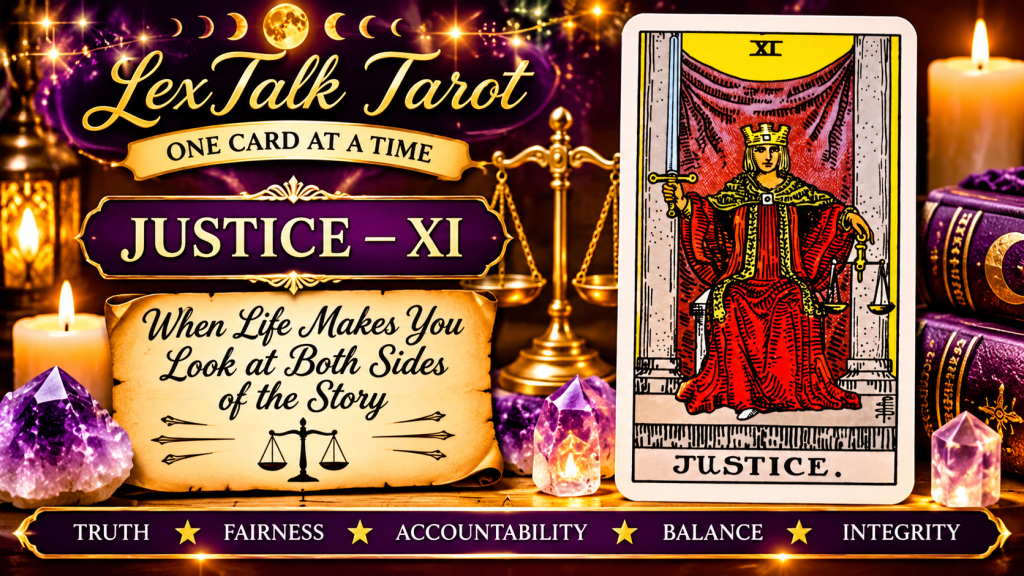
Welcome back to LexTalk Tarot: One Card at a Time! 

We’ve officially reached Card #30 of 78, and today we’re exploring another Major Arcana card.
This one is traditionally associated with:
Truth.
Fairness.
Accountability.
Integrity.
Balance.
Cause and effect.
And perhaps the most annoying one… Looking at BOTH sides of the story.
Today we’re learning about…
JUSTICE — XI
And my beginner memory trick for this one is:
Justice = Own your choices and let the truth speak.
Because Justice isn’t necessarily about getting revenge.
It isn’t:
DON’T WORRY. KARMA WILL GET THEM.

That’s a VERY tempting interpretation sometimes.
But I think Justice is more complicated than that.
It asks us to look at facts.
Actions.
Consequences.
Our values.
Our decisions.
And yes… sometimes our OWN behavior.
Rude.
Let’s investigate.
Meet Justice
Card: Justice
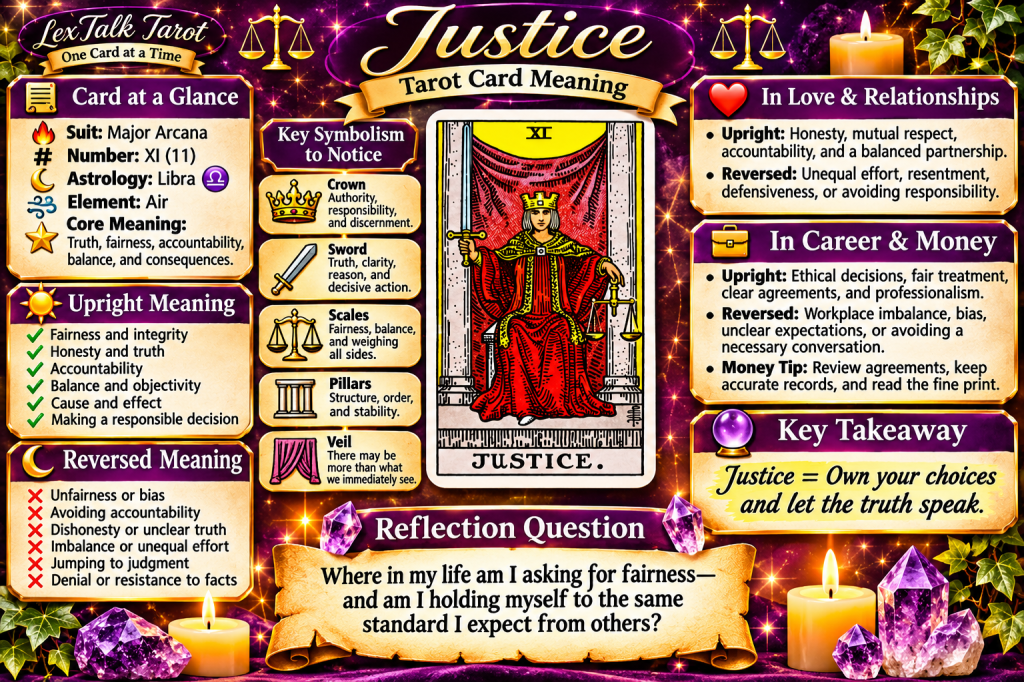
Number: XI — 11 in the Rider-Waite-Smith deck
Arcana: Major Arcana
Traditional Astrological Association: Libra
Elemental Association: Air
Core Themes: Truth, fairness, accountability, integrity, balance, consequences
Justice belongs to the Major Arcana, meaning we’re dealing with one of tarot’s larger archetypal themes.
And this card is VERY visually straightforward.
A seated figure.
A sword.
A set of scales.
Two pillars.
A crown.
Everything about this card feels… official.
Like we’ve entered tarot court.
But the more I studied the imagery, the more I realized Justice isn’t only about judging someone ELSE.
It’s about evaluating ourselves too.
And THAT makes this card much more interesting.
 Let’s Study Justice
At first glance, Justice doesn’t have quite as much chaos happening as some of the cards we’ve studied.
No falling towers.
No chained people.
No creepy moon crayfish.
Instead?
Everything feels controlled.
Balanced.
Structured.
And that’s intentional.
Let’s investigate the symbols.
The Scales
Obviously… we have to start here.
Justice holds a set of scales.
And honestly?
This is probably one of the easiest tarot symbols to understand.
Scales traditionally represent:
Balance
Fairness
Evaluation
Weighing evidence
Considering multiple perspectives
The scales aren’t wildly tipping to one side.
They’re balanced.
Which immediately makes me think about something important.
When we’re emotionally involved in a situation… we usually don’t start from a completely neutral place.
We know how WE feel.
We know what WE experienced.
We know what THEY did.
We know why WE reacted.
But Justice asks:
What happens if I put everything on the scales?
Not just the evidence supporting my side.
Everything.
Scales = Fair evaluation and considering the whole picture.
And I think that’s one of the biggest lessons of this card.
 The Upright Sword
In Justice’s other hand is a sword held straight upward.
And the sword adds an entirely different energy to the card.
Swords in tarot are commonly associated with:
Thought
Truth
Communication
Logic
Clarity
Decision-making
Justice isn’t holding the sword sideways.
It points upward.
Clear.
Direct.
Decisive.
Sword = Truth, clarity, reason, and decisive action.
And I think the sword balances the scales beautifully.
Because it’s not enough to evaluate forever.
Eventually… we have to decide. We gather information. We consider perspectives. We weigh the evidence.
And then?
We choose what happens next.
 The Crown
Justice wears a crown.
Which immediately communicates:
Authority
Responsibility
Discernment
Mental clarity
This isn’t someone casually giving an opinion.
There’s responsibility attached to judgment.
And I think that’s important.
Because our decisions affect things.
Our words affect people.
Our actions create consequences.
Crown = Authority, discernment, and responsibility.
Maybe Justice isn’t only asking:
What decision do I WANT to make?
Maybe it’s asking:
What decision can I actually stand behind?
 The Red Robe
Justice wears a bright red robe.
Red is often associated symbolically with:
Action
Strength
Passion
Energy
And I find that interesting because Justice isn’t purely intellectual.
There’s action involved.
We can THINK about fairness all day.
But eventually?
Our behavior has to reflect it.
Red Robe = Action and responsibility.
Integrity isn’t something we simply believe we have.
It shows up in what we actually DO.
OOOF.
 The Two Pillars
Justice sits between two pillars.
And if those look familiar… GOOD.
We’ve seen pillars before.
The High Priestess also sits between two pillars.
But the energy here feels different.
With Justice, the pillars reinforce:
Structure
Balance
Order
Stability
They frame the figure almost like a courtroom.
Pillars = Structure, balance, and order.
Which makes sense.
Fairness needs some kind of structure.
Otherwise we’re just changing the rules depending on who we like.
 The Veil
Behind Justice is a purple veil.
Veils in tarot often suggest that there’s something beyond what we immediately see.
Which feels VERY appropriate for this card.
Because how often do we think we understand an entire situation… when we actually know about 40% of it?
Maybe less.
The veil reminds me that there’s often context we don’t have.
Motivations we don’t understand.
Information we haven’t heard.
Veil = What may exist beyond our immediate understanding.
Which doesn’t mean we ignore what we DO know.
It means we remain open to learning more.
 Justice Upright Meaning
When Justice appears upright, common themes include:
Truth • Fairness • Integrity • Accountability • Responsibility • Balance • Cause and Effect
This card may invite us to step back and look at a situation objectively.
What actually happened?
What do we know?
What are we assuming?
What role did each person play?
What consequences naturally followed?
And most importantly… What part of this belongs to ME?
Because accountability isn’t only about identifying what someone else did wrong.
Sometimes it’s:
They shouldn’t have done that.
AND… I could have handled this part differently.
Both things can be true.
Upright Message:
Being right isn’t always the same as being fair.
OOOF.
 Justice Reversed Meaning
And you already know our LexTalk rule!
REVERSED DOES NOT AUTOMATICALLY MEAN BAD.
Common reversed Justice themes include:
Unfairness • Bias • Avoiding Accountability • Dishonesty • Imbalance • Denial • Unclear Judgment
Maybe something genuinely isn’t fair.
Because let’s establish something VERY important:
LIFE IS NOT ALWAYS FAIR.
Justice appearing in tarot does not guarantee that fairness will magically prevail.
Sometimes people behave badly and face no obvious consequences.
Sometimes good people get hurt.
Sometimes systems fail people.
Sometimes outcomes aren’t fair.
Tarot doesn’t change that.
But reversed Justice can ALSO invite us to examine our own perspective.
Are we avoiding responsibility?
Are we judging someone more harshly than we’d judge ourselves?
Are we only collecting evidence that supports what we already believe?
🌑 Reversed Message:
Am I looking for the truth—or am I looking for proof that I’m right?
Well… that’s uncomfortable.
Fair Doesn’t Always Mean Equal
THIS is something Justice makes me think about.
Fair and equal aren’t always the same thing.
Imagine three people need help reaching something on a shelf.
One is tall enough already.
One needs a small stool.
One needs a taller stool.
Giving everyone the exact same stool would technically be equal.
But it might not actually meet everyone’s needs.
Justice encourages us to think beyond:
Everyone gets exactly the same thing.
Sometimes fairness requires context.
Different circumstances.
Different needs.
Different responsibilities.
And THAT makes fairness much more complicated than simply dividing everything perfectly down the middle.
Accountability Without Self-Blame
I think this distinction is REALLY important.
Accountability means:
What part of this belongs to me?
Self-blame says:
Everything is my fault.
Those are NOT the same.
You can acknowledge:
I shouldn’t have said that.
without saying:
Therefore everything that happened is my fault.
You can acknowledge:
I ignored a red flag.
without saying:
Therefore I deserved what happened.
You can acknowledge:
I could have communicated better.
without excusing someone else’s behavior.
Justice asks us to take responsibility for OUR piece.
Not everyone else’s.
Accountability is not the same thing as taking the blame for everything.
I REALLY like that distinction.
 Intentions vs. Impact
Here’s another Justice lesson.
We LOVE judging ourselves by our intentions.
But I didn’t MEAN it like that!
Okay.
Maybe you didn’t.
Intent matters.
But impact matters too.
Sometimes we can have good intentions… and still hurt someone.
Justice doesn’t necessarily require us to declare ourselves terrible people.
It might simply ask:
What happened?
What was the impact?
What can I do differently?
You can have good intentions and still apologize.
You can make a mistake without becoming a bad person.
Accountability doesn’t require self-destruction.
It requires honesty.
 Fairness Isn’t Revenge
THIS ONE.
Sometimes when we’ve been treated badly, what we REALLY mean when we say:
I just want things to be fair…
is:
I would like karma to arrive immediately with documentation.
Preferably while I’m there to watch.
But Justice isn’t necessarily revenge.
Justice is about accountability and appropriate consequences.
And sometimes the consequence isn’t dramatic.
Sometimes it’s simply:
You lose access to me.
I stop participating.
I set a boundary.
I change my expectations.
I document what happened.
I make a different decision next time.
I move forward.
We don’t always need front-row seats to someone else’s consequences.
 Justice & Confirmation Bias
Okay… tiny psychology moment.
Humans have something called confirmation bias.
Basically?
We tend to notice information that supports what we already believe.
If I believe someone doesn’t like me… suddenly EVERYTHING becomes evidence.
They didn’t respond quickly?
SEE?!
They walked past me?
SEE?!
They used a period instead of an exclamation point?
CLEARLY WE ARE ENEMIES.
Meanwhile… there could be twelve completely unrelated explanations.
Justice reminds me to ask:
What do I KNOW?
versus:
What story have I created around what happened?
Sound familiar?
Our Moon card touched on this too.
Tarot cards overlap because… well… humans are complicated.
Justice in Love & Relationships
In relationships, Justice can connect with:
Honesty • Mutual Respect • Accountability • Fairness • Balanced Effort • Clear Communication
And I think there’s a REALLY important relationship question here:
Are we holding each other to the same standards?
If I expect honesty… am I honest?
If I expect communication… do I communicate?
If I expect respect… am I respectful?
If I expect someone to apologize when they’re wrong… can I apologize when I’M wrong?
OOOF.
Upright Love Reflection:
Are both people taking responsibility for their own actions and contributing fairly to the relationship?
That doesn’t necessarily mean everything is 50/50 every single day.
Life doesn’t work that way.
Sometimes one person needs more support.
Sometimes the other does.
But over time?
There should be mutual effort.
Justice Reversed in Love
Reversed relationship themes can include:
Unequal Effort • Resentment • Defensiveness • Dishonesty • Avoiding Accountability • Feeling Unheard
Maybe one person feels like they’re carrying everything.
Maybe arguments never actually get resolved.
Maybe someone refuses to acknowledge their part.
Or maybe BOTH people are so focused on proving they’re right that nobody is actually listening.
Justice reversed might ask:
Do I want resolution—or do I want to win?
Those aren’t always the same goal.
And tarot can’t tell us whether someone is secretly lying, cheating, or behaving dishonestly.
If something concerns you, direct communication and real-world evidence are much more useful than assuming a tarot card proves it.
 Justice in Career
Career is another area where Justice makes A LOT of sense.
Common themes include:
Professionalism • Ethics • Fair Treatment • Contracts • Accountability • Decisions • Clear Expectations
Maybe you’re reviewing an agreement.
Maybe you’re negotiating.
Maybe there’s a workplace conflict.
Maybe you’re asking whether something is equitable.
Maybe you need clearer expectations.
Justice encourages:
DOCUMENTATION.
And as someone who works in accounting?
YES.
Receipts.
Emails.
Records.
Agreements.
Numbers.
Details.
Because:
BUT I THOUGHT…
is not nearly as useful as:
HERE IS THE EMAIL.
Career Reflection:
Are expectations, responsibilities, and agreements actually clear—or am I assuming everyone understands them the same way?
Justice Reversed in Career
Reversed career themes can include:
Perceived Unfairness • Bias • Unequal Treatment • Workplace Conflict • Unclear Expectations • Avoiding Responsibility
And I purposely said:
PERCEIVED unfairness.
Because sometimes something IS unfair.
And sometimes we simply don’t have all the information.
Justice asks us to gather facts before reaching conclusions.
Document.
Ask questions.
Clarify expectations.
And if something genuinely is wrong?
Then we can make decisions based on evidence rather than assumptions.
 Justice & Money
Justice is VERY practical when it comes to money.
This card makes me think about:
Contracts
Bills
Debt
Budgets
Financial Obligations
Records
Agreements
Reading the fine print
AKA… all the fun stuff.
Justice doesn’t mean:
MONEY IS COMING!
No.
It says:
PLEASE READ WHAT YOU ARE SIGNING.
Honestly?
Useful.
Money Reflection:
What financial obligation, agreement, or decision deserves a closer look?
Maybe it’s reviewing spending.
Checking interest rates.
Reading a contract.
Understanding repayment terms.
Looking at statements.
Whatever it is… information gives us power.
And obviously, tarot should never replace professional financial or legal advice.
 Hold Yourself to the Same Standard
This might be THE lesson I’m taking from Justice.
Because it’s easy to recognize when someone ELSE does something wrong.
We’re excellent at that.
But Justice turns the scales toward us too.
If I want grace when I make a mistake… do I give grace?
If I want someone to hear my side… do I listen to theirs?
If I hate being judged unfairly… am I making assumptions about someone else?
If I expect accountability… am I willing to practice it?
That doesn’t mean tolerating disrespect.
It doesn’t mean ignoring patterns.
It doesn’t mean giving endless chances.
It means making sure our standards aren’t conveniently changing depending on which side we’re standing on.
OOF.
 Justice & Boundaries
I also think Justice connects beautifully with boundaries.
Because boundaries aren’t punishment.
They’re information.
If X happens, I will do Y.
Not:
YOU MUST DO THIS.
That’s control.
A boundary focuses on what WE will do.
For example:
If someone repeatedly speaks disrespectfully to me, I will end the conversation.
That’s different from:
You are not allowed to speak to me that way ever again.
We can’t actually control another person’s behavior.
We can control their access to us.
And THAT feels very Justice.
Actions.
Choices.
Consequences.
Justice Is NOT a Guaranteed Karma Card
I REALLY want to emphasize this because Justice gets interpreted this way A LOT.
Someone hurts you.
Justice appears.
And suddenly:
KARMA IS COMING.
Maybe.
Maybe not.
Tarot cannot guarantee that someone will receive punishment.
Justice doesn’t promise:
They’ll regret it.
They’ll get caught.
They’ll come crawling back.
The universe will punish them.
Sometimes the most meaningful form of Justice is much less dramatic.
Maybe YOU recognize the pattern.
Maybe YOU stop accepting the behavior.
Maybe YOU choose differently.
Maybe YOU move forward.
And maybe that is enough.
 Today’s LexTalk Tarot Journal Prompt
Grab your tarot journal!
Today’s main question:
Where in my life am I asking for fairness—and am I holding myself to the same standard I expect from others?
OOOF.
And here’s another one I LOVE:
Am I looking for the truth—or am I looking for proof that I’m right?
A few more:
What do I actually know about this situation?
What am I assuming?
What part of this situation belongs to me?
What part does NOT belong to me?
Where do I need stronger accountability?
Where am I taking responsibility for something that isn’t mine?
Do my actions match my values?
Where might I be judging someone more harshly than I judge myself?
What decision can I make that Future Me will respect?
And finally:
If I removed my ego from this situation, what would feel fair?
That’s a GOOD one.
The Tarot Deck I’m Learning With
Justice is another PERFECT example of why I’m enjoying learning tarot through Rider-Waite-Smith imagery.
Instead of memorizing:
Justice = Fairness.
I can look at the card and remember:
Scales = Fairness and evaluation
Sword = Truth, clarity, and decisions
Crown = Responsibility and discernment
Red Robe = Action
Pillars = Structure and balance
Veil = There may be more than what we immediately see
And suddenly… I understand the STORY.
Throughout LexTalk Tarot, I’m using a physical Rider-Waite-Smith style tarot deck because studying the artwork helps me understand each card rather than simply memorizing definitions.
If you’d like to learn alongside me using the same style of deck, you can [check out the tarot deck I’m using here — paid link].
You absolutely don’t need my exact deck to follow along. I’m simply sharing what I’m personally use throughout this journey.
As an Amazon Associate, I earn from qualifying purchases.
Learning Tarot With a Journal
I’m also keeping notes about every card in a tarot journal.
And today’s extremely sophisticated beginner memory system?
SHE HAS THE RECEIPTS.
Scales?
Evidence.
Sword?
Truth.
Expression?
She’s not interested in your excuses.
Honestly… I WILL remember Justice now.
If you’re learning tarot alongside me, any notebook works perfectly.
But if you’d like a dedicated place for tarot meanings, symbolism, personal interpretations, and reflection prompts, you can [check out the tarot journal I recommend here — paid link].
As an Amazon Associate, I earn from qualifying purchases.
How I’m Remembering Justice
Beginner tarot friends… Don’t memorize this entire blog.
Here’s today’s cheat sheet:
JUSTICE — XI
Core Meaning: Truth, fairness, and accountability
Upright: Fairness, honesty, integrity, accountability, balance, responsibility
Reversed: Unfairness, bias, dishonesty, imbalance, avoiding accountability
Scales: Fair evaluation and balance
Sword: Truth, clarity, and decisive action
Crown: Responsibility and discernment
Red Robe: Action
Pillars: Structure and order
Veil: There may be more to understand
Traditional Astrological Association: Libra
Elemental Association: Air
And today’s beginner memory trick:
Justice = Own your choices and let the truth speak.
Done.
One card.
One story.
 30 Cards Into LexTalk Tarot!
WAIT.
THIRTY?!
We’ve officially explored:
30 OF 78 TAROT CARDS!
That’s more than 38% of the entire deck!
And I think that’s pretty freaking cool.
Because when I started this series, learning 78 cards sounded like A LOT.
Upright meanings.
Reversed meanings.
Symbols.
Numbers.
Elements.
Astrology.
Relationships.
Career.
Money.
And approximately 9,000 tiny details.
But learning them one at a time?
Suddenly 78 doesn’t feel impossible.
We’ve already learned THIRTY.
And that’s kind of a Justice lesson itself.
Actions have consequences.
Small choices accumulate.
One blog.
One card.
One day.
One lesson.
And suddenly?
THIRTY CARDS.
Maybe progress doesn’t always announce itself while it’s happening.
Sometimes we only notice when we stop and count.
 One Last LexTalk Thought
Justice might not be the warmest, coziest tarot card we’ve explored.
It doesn’t exactly scream:
RELAX, BABE. EVERYTHING WILL WORK OUT.
Instead?
It sits there with its scales and sword like:
Okay.
But what actually happened?
And maybe we need that sometimes.
Because our feelings are real.
But our feelings aren’t always the entire story.
Our perspective matters.
But it isn’t necessarily the only perspective.
Someone else can behave badly… and we can still examine our own response.
We can admit we made a mistake… without accepting responsibility for everything.
We can forgive someone… without giving them unlimited access to us.
We can set a boundary… without needing revenge.
We can change our minds when new information appears… without feeling embarrassed that we didn’t know everything before.
And maybe THAT is what integrity looks like.
Not being right all the time.
Not being perfect.
Not never making mistakes.
But being willing to say:
Here’s what I know.
Here’s what I did.
Here’s what I could have done differently.
Here’s what isn’t mine to carry.
And here’s what I’m choosing now.
That feels much more powerful to me than waiting around for the universe to punish everyone who has ever pissed me off.
Although… I’m kidding.
Mostly.
Justice reminds me that I don’t need to control someone else’s consequences.
I need to pay attention to my choices.
My standards.
My values.
My actions.
My side of the scales.
Because at the end of the day… maybe the question isn’t:
Who was right?
Maybe it’s:
Did I behave in a way I can stand behind?
And THAT?
That’s a standard I can actually control.
Justice = Own your choices and let the truth speak.
One card. One lesson. One little bit of magic at a time.
— Lex 
Tarot interpretations are subjective and are shared here for personal reflection, education, and entertainment. Tarot should not replace professional medical, legal, mental health, or financial advice.


Leave a Reply